The Iowa Caucuses

Today is the single most important day in the Democratic Primary. Although just 41 pledged delegates are up for grabs tonight, the results and their interpretation will have knock on effects on the rest of the country.

Iowa Predictions

Current Iowa polling shows Sanders and Biden effectively tied with 23% and 22% of the vote respectively. Buttigieg and Warren have each fallen to approximately 15%, while Klobuchar has surged to 11%. However, a naive assessment of these first choice preferences is insufficient in understanding who might win, Iowa is much more complex than that. For each local caucus, candidates who receive 15% or more of first choice preferences immediately bank those votes. However, people who initially supported candidates with less than 15% of the vote will have one opportunity to realign. They could vote for candidates who have already passed the threshold, they could simply go home, or they could support other candidates below the threshold to try and get them up to the 15% mark.

The impact of this system is that second preferences become immensely important. Bear in mind that Iowa voters are generally exceptionally well informed on the candidates due to the intensity of campaigning there, so many will have a well thought out list of preferences. Generally speaking, the field could be sorted into a moderate lane dominated by Biden and Klobuchar and a progressive lane dominated by Sanders and Warren, with Buttigieg in the middle. One would expect voters’ second choices to be from the same ideological lane as their first choice. Campaigns have explicitly reached out to one another to encourage their supporters to select each other as their second choices. The voters themselves will be in the room attempting to convince those realigning to come and support their candidate, all of which makes the process very challenging to predict.

Further complicating matters is the system of delegate allocation, with just 14 delegates being awarded based on the statewide popular vote, and the remaining 27 split between Iowa’s 4 congressional districts. Not only will the allocation be related to the candidates’ popularities in a non-linear manner due to the system of realignment and the 15% threshold, but some of the delegate allocation will be very approximate. Delegates afterall, are people, no candidate can win half a delegate, so the resolution of the system is very low. For example, the 4th congressional district has just 5 delegates, so candidates with very different vote totals could receive the same number of delegates. Furthermore, a candidate with only a few more votes than a competitor could just pip them to the post for an extra delegate, winning far more representation despite having similar vote totals. Currently, our model is predicting that on average, Sanders will win the caucus with 14 delegates. He will be followed by Biden with 12, Warren and Buttigieg with 6 each, Klobuchar with 2, and another candidate with 1, most likely Yang or Steyer.  It is worth noting that these predictions come with a very high degree of uncertainty owing to the complexity of the process.

Media Narratives

This year, for the first time, Iowa will release 3 sets of results. Historically, Iowa simply released the number of delegates allocated to each candidate. However, this year, both the first preference totals and the votes after realignment will be released. It is entirely plausible that these metrics will not all be won by the same candidate, potentially resulting in 2 or even 3 candidates declaring victory tomorrow! Whether or not that happens, the media narrative regarding the results will guide the public interpretation of them. This is not trivial, it is the public interpretation of the Iowa results, especially in terms of tactical voting and changing perceptions of which candidates are electable, which makes Iowa so important. Essentially, it doesn’t help a candidate much to win 13 delegates instead of 12, what matters is whether or not CNN declares them the winner.

Typically, the winner in Iowa receives a substantial bump in the polls. This might be more complicated this year due to potential disagreement over who the “winner” is, but remains electorally crucial. The popularity boost the winner gains is usually greater if they were not expected to win, indeed it may be more useful to consider each candidate’s performance not against one another, but against the respective expectations of each candidate. Currently, the media narratives are effectively, as ever, following intelligent averages of the polls but not accounting enough for uncertainty. Hence Sanders is broadly expected to win a narrow victory over Biden, and Buttigieg has largely fallen out of media coverage. In fact, it is still perfectly likely that any of the top four candidates could win in Iowa, although Sanders does have the best chance. High expectations of Sanders could limit the boost he receives should he win, whereas the potential upside for Buttigieg is massive, something he is counting on given his weak national polling.

Finally, candidates for whom expectations are very low can gain in the polls simply by coming second or third, exceeding expectations. This is effectively what Klobuchar is banking on. With 3 different sets of results it is also plausible that multiple candidates will be clamouring to claim second or third place. As you can probably tell, this is all becoming rather confusing and far too complicated to fit into a typical TV news segment. The manner in which journalists navigate this sea of information, and the spin candidates put on the results, will have a profound impact on the remainder of the primary.

Introducing Our 2020 Democratic Primary Model

There are a lot of conflicting media narratives about the race for the Democratic nomination. Is Biden falling in the polls? Is Warren a “front-runner”? Is Hilary Clinton about to leap into the race and cruise to victory? In such a large and chaotic field engaging in equally numerous and confusing arguments, it can be difficult to see past exaggerated news articles and the biases of those writing them. One way to decode this information is by simply ignoring all the punditry and going straight to the data. That’s why we’ve created a new probabilistic model to provide an overview of how data, not people, predict the primaries are going to go.

Our model draws on polls from dozens of organisations including national and state level research. Combined with data on historic voting patterns and the political similarities of various states, we simulate the primary, including adding random variations to polling averages to model uncertainty. After thousands of simulations, the results are averaged, allowing us to analyse results in individual states and the nation overall.

The headline is that Joe Biden is clearly in the lead. Elizabeth Warren is in second and Bernie Sanders third. That said, pollsters are coming to differing conclusions on the state of the race. Some give Biden double-digit leads on his competitors, others put Warren and Sanders neck and neck or even slightly ahead of the former Vice President. These differences are mainly due to the differing sampling techniques polling organisations employ, and it’s very difficult to say which are more representative of the truth. Our model takes an average of the results, affording more weight to pollsters with strong records and large sample sizes.

PC Dels Won

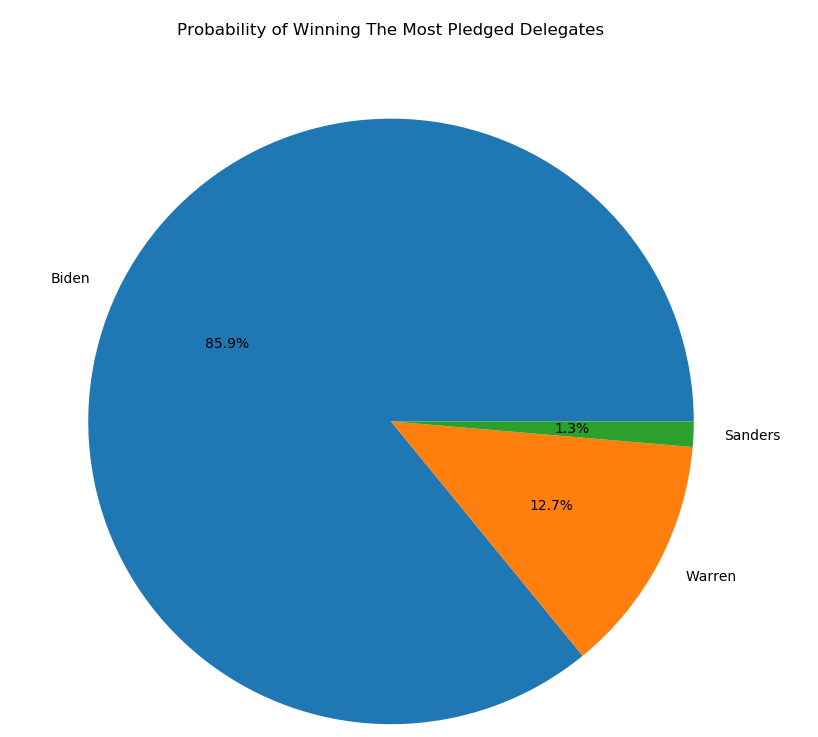
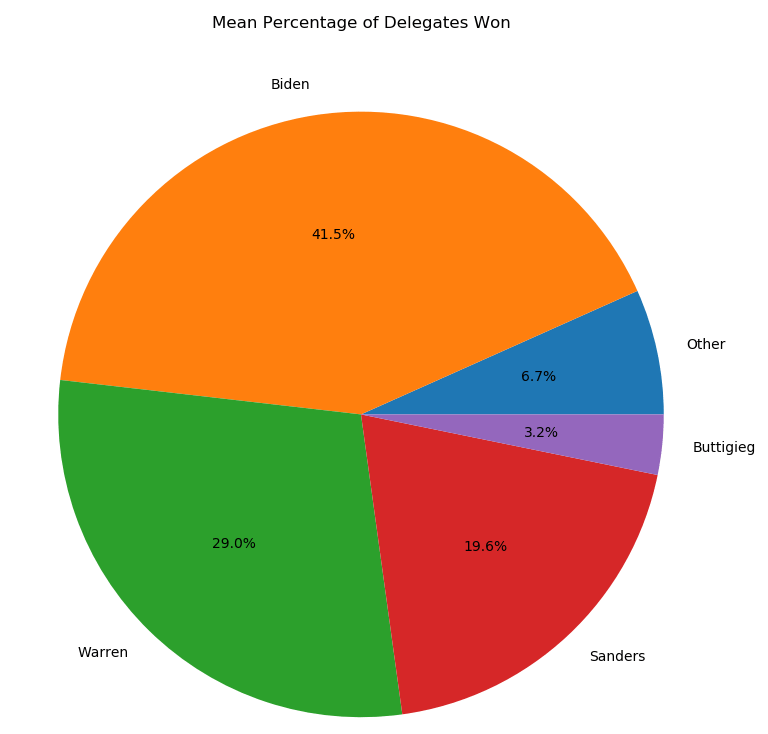
You may wonder why so few candidates are winning a significant number of delegates despite the crowded field. This is down to the all important 15% threshold. Each delegate is attached to either a particular district in a state or to the state as a whole. If a candidate fails to win at least 15% of the vote in a particular district, that candidate receives none of the district’s delegates. If they win less than 15% of the overall state vote, they win none of the statewide delegates. This makes the primary very punishing for anyone but the top three, who are the only candidates consistently polling above the threshold. The chart also demonstrates Biden’s significant lead, which appears even more pronounced when we focus in on how likely each candidate is to win the most delegates.

Most Pledged Dels

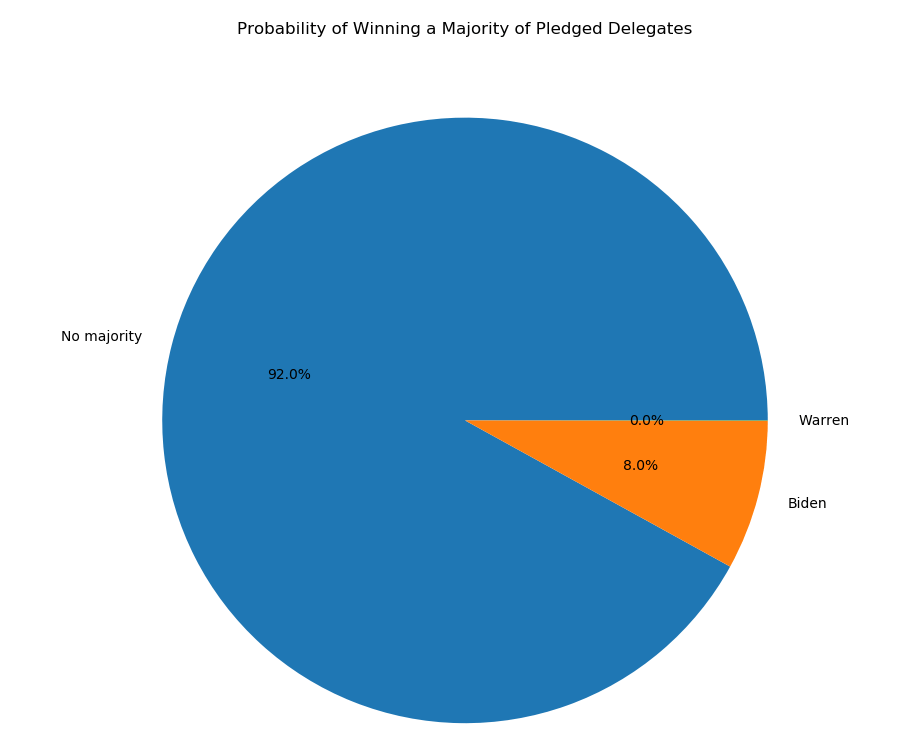
Although he may be winning the most pledged delegates, Biden is still struggling to win an outright majority of them. So long as this is a three horse race that could be a major issue for all the candidates. If nobody controls a majority of pledged delegates by the time the national convention in Wisconsin comes around, superdelegates will get involved. If they can’t push one candidate to an overall majority, there could be an unpredictable brokered convention. This could be quite likely according to the current data, as more than 90% of the time, nobody secures a majority in the first round of voting at the convention.

Majority Pledged Dels

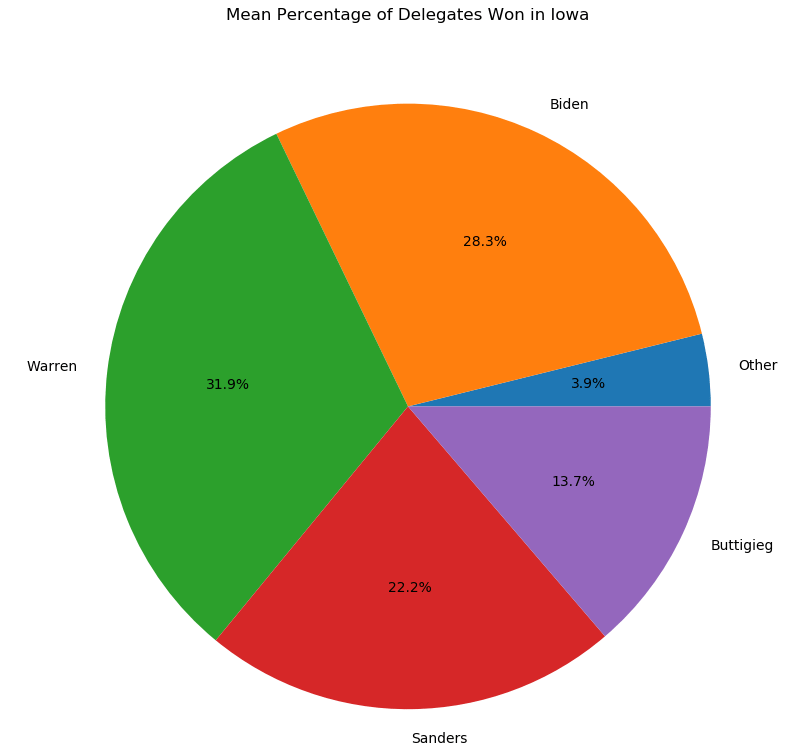
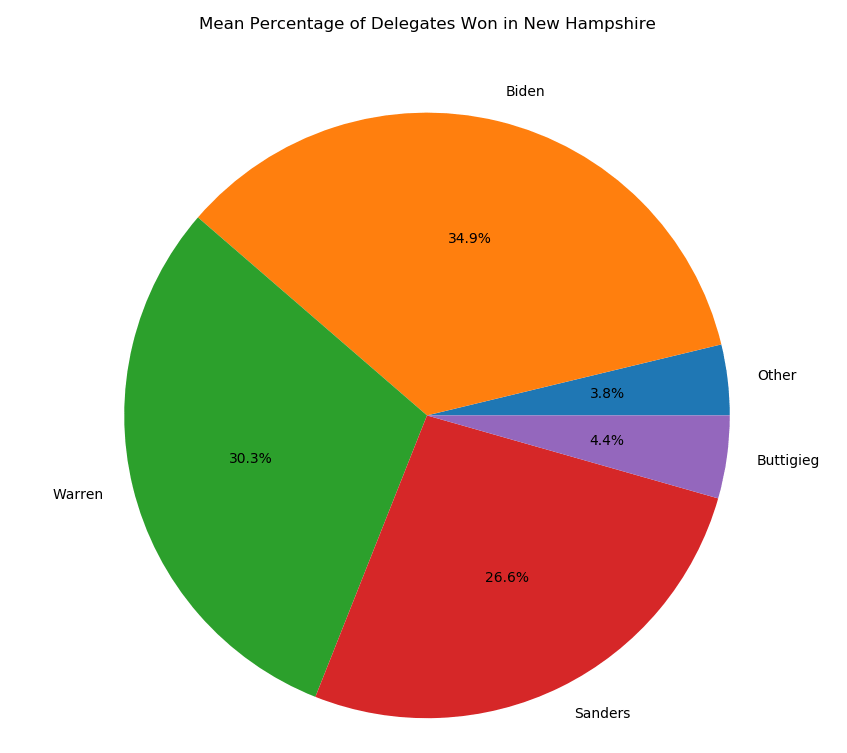
The chaotic nature of this primary doesn’t stop there though. Iowa and New Hampshire are looking to be highly competitive three or even four way races. Pete Buttigieg is gaining ground in Iowa, reaching second place with 20% of the vote in his best polls. By contrast, Biden is struggling in the two earliest voting states. He could very conceivably come fourth in Iowa and then third in New Hampshire, meaning that even if he does win this primary, it will hardly be a coronation, as he is reported to have been expecting when he joined the race. Our model does simulate voters changing their minds in response to the results of earlier primaries, with our calculations based on voter behavior in previous primaries. However, this year features an exceptionally large number of candidates, and the front-runner coming fourth in Iowa would be unusual, so there is a high degree of uncertainty involved. Therefore it’s important to keep track of simulation results in early states as well as the primary overall.

Iowa

NH

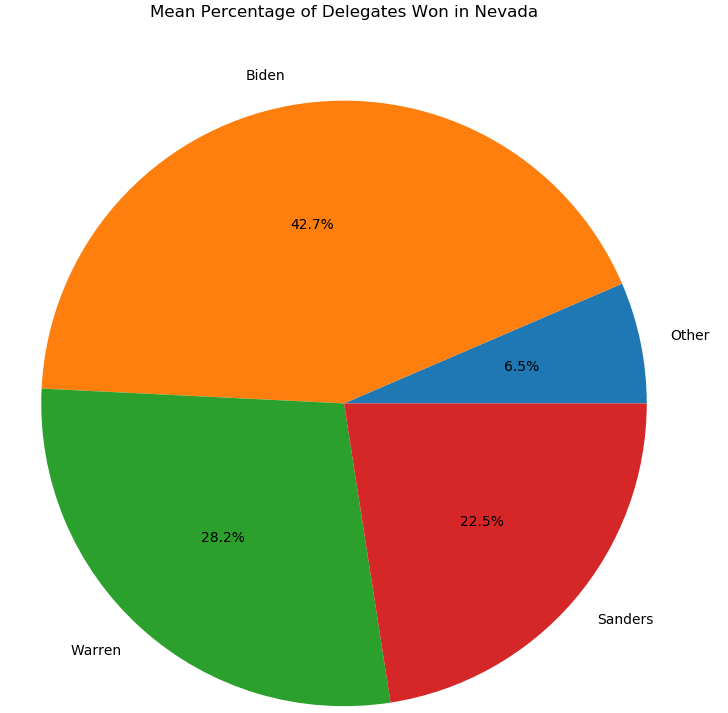
Iowa and New Hampshire are not especially diverse states. Many Democrats there are the white college-educated voters who form Warren and Buttigieg’s bases, explaining their above average performance in these early states. However, the often overlooked but still crucial Nevada and South Carolina also vote before Super Tuesday, when over a third of pledged delegates are assigned, and play a key role in shaping the narrative of the race early on. These two states are a lot more racially diverse than Iowa and New Hampshire, allowing Biden to thrive. In some polls Warren and Sanders are struggling to even reach 15% in South Carolina due to their low support among people of color, a severe problem they face in much of the South.

Nevada

SC

Overall, the race continues to be a highly competitive affair. But with many candidates struggling to qualify for the December debate it may start to become a little easier to follow. There are surely plenty of twists and turns left, such as Michael Bloomberg considering entering the race. And there’s still everything to play for as the majority of key party figures, such as Obama, are yet to issue endorsements, and most voters are still considering multiple candidates.

Top 6 2020 Presidential Frontrunners

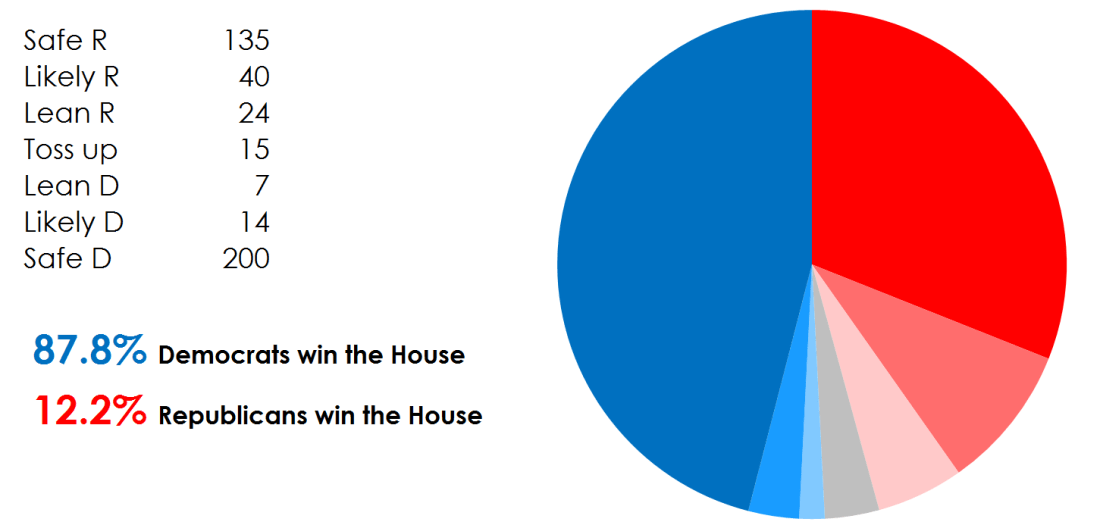
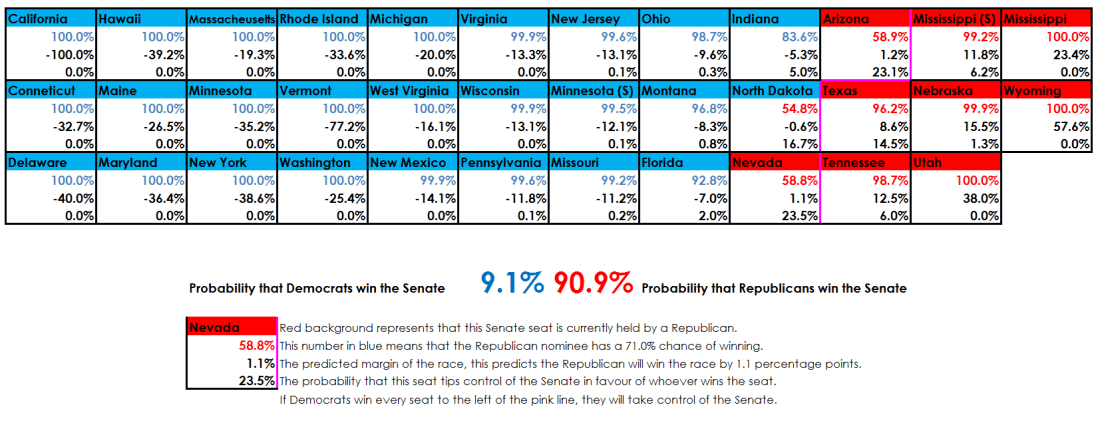
Predictions as of 10/22/2018, as Republicans take a lead in Nevada and Arizona, they look almost sure to hold on to the Senate, while Democrats’ popular vote lead sees them well ahead in the House:

22_10predictions2

22_10predictions

The 2020 Presidential campaign began on Wednesday November 9th 2016, when America woke up to discover Trump’s victory. The race may not officially begin until late 2019, but the battle has already begun, and is sure to intensify the day the midterms are done. Since 2016, the President has made it clear that he intends to run for re-election in 2020, and a rather large number of Democrats have been setting themselves up to challenge him, not to mention several #NeverTrump Republicans. But who actually has a chance of winning?

6. Vice President Joe Biden

On first glance, Joe Biden is a strong candidate for the Presidency. He has the name recognition to cut through a Democratic nomination process that could easily involve 20+ candidates. With 7 terms in the Senate and 2 terms in the Vice-Presidency, no one could ever question his experience. Combine this with his close relation to Obama, who is now seen as practically the father of modern Democratic politics, and he seems a strong contender to win the nomination. Having done so, he could run a campaign on his traditionally moderate politics. He’s always tried to position himself as a man of the people, and his trips to Wisconsin and Michigan clearly indicate some thought about a potential 2020 strategy. Add to this the fact that he was born in Pennsylvania, perhaps the most important swing state in the country at the moment, and he may seem like the perfect answer to Trump.

But Biden has run for the Presidency twice before, in 1988 and 2008, losing horribly both times. 1988 is particularly interesting, as Biden was considered a strong candidate from the very beginning, until he was destroyed by a long string of controversies: Accusations of plagiarizing speeches from the leader of the British Labour Party, as well as Robert F. Kennedy, John F. Kennedy, and Hubert Humphrey; involvement in plagiarism whilst he was at law school; lying about graduating in the top half of his class (he came 76th/85); claiming he earned 3 degrees when in fact he only got 1; and claiming that he received a full scholarship, when in fact he only got a half-scholarship. Biden is also, to be blunt, very old, currently aged 75. This means that by the end of a two term Presidency starting in 2021, he would be 86 years old. On top of the obvious mental and physical health concerns associated with this, it’s worth noting that during the primaries for the midterms, Democrats have tended to prefer younger, female candidates, and anti-establishment candidates have also been doing a little better than expected. Joe Biden is very strong on paper, and has a perfectly good shot, but it seems as though his time has probably come and gone.

5. Senator Kirsten Gillibrand

So how about a young(er), more liberal, female Democrat? Elected once to the House and thrice to the Senate, soon to become four times as she romps to victory in her New York re-election bid, Kirsten Gillibrand may well be the new face of the Democratic Party. With the weight of the mighty New York Democrats behind her, she is a fundraising titan, with $20 million raised towards defending her perfectly safe Senate seat this cycle alone. And though she may be a full blown liberal today, at the beginning of her political career she was a much more moderate Democrat, something she could plausibly call upon once she’s got the nomination in the bag and needs to appeal to the nation as a whole. On the other hand, her ties to the Clinton family and her being a female New York Democrat may well make it very easy for her to become linked in voters’ minds to Hillary Clinton, which would almost certainly not be a good thing for her campaign. Interestingly, unlike some on this list, she hasn’t yet visited Iowa or New Hampshire, the early primary states, which is considered a key step in building up for a Presidential campaign. Even unconventional candidates like Trump visit these states well before the primaries begin, so this might indicate that she isn’t yet sure about running in 2020, hence her place near the bottom of this list.

4. Senator Kamala Harris

Who’s an even more powerful and wealthy ally in a Democratic primary process than the New York Democrats? The California Democrats of course! Kamala Harris is one of a tiny group of candidates who could have a chance at outmatching Gillibrand on fundraising, and is another comparatively young female Senator. She’s even more liberal than Gillibrand, and although she is relatively new to the Senate, this could almost work in her favour, as younger Democrats seem keen to get rid of the old guard of the Party. As if this weren’t enough, she is the best candidate on this list for appealing to the Democrats’ African-American base, which is crucial during primaries. This could also be very useful during a general election. Although many Democrats believe that their path to victory in 2020 is to regain the Upper Midwest, specifically Wisconsin, Michigan, and Pennsylvania, this is hardly their only plausible route. By motivating African-American turnout, Harris could make a serious play for Florida and North Carolina, and perhaps even make Georgia and Arizona genuinely competitive. With the Trump campaign also needing to defend slim and faltering majorities in the Upper Midwest, this strategy could make for a very strong campaign indeed.

3. Senator Bernie Sanders

To all intents and purposes, Bernie Sanders is already running for President. His 2016 campaign never truly ended, and support for him is still strong within the party. He’s visited the early primary states of Iowa, New Hampshire and South Carolina, and even has a book out this year. The real question is not whether he will run, but whether he can win. We can clearly see from the 2016 primaries that he has a lot of support, he won 43% of delegates and only narrowly lost the popular vote to Hillary Clinton. That said, Clinton was not an especially popular candidate among Party members, hardly inspiring the levels of enthusiasm Obama or Sanders generated. So if Sanders couldn’t beat Clinton, could he beat any of the candidates on this list?

Furthermore, at 77 he’s even older than Biden, there has been some talk of a one term pledge, where he promises not to run for re-election, but not from Sanders himself, and it’s likely that such a pledge would harm him during the nomination process as Democrats will be keen to get a strong incumbent into office to secure a win in 2024. In a general election, he may struggle due to being perceived as a socialist, which is still a word with strong negative associations for many Americans, particularly those in high turnout demographics. Despite all this, he is almost definitely running, he has an established base of enthusiastic supporters, and extreme views are growing more popular and electable, as President Trump shows. Sanders is going to be a political heavyweight during the primaries, and his chances should not be underestimated.

2. Senator Elizabeth Warren

Elizabeth Warren is Hillary Clinton’s natural successor, and the one to watch in the Democratic primaries. She has her finger on the pulse of the party, is generally a very skilled politician, and has incredible fundraising abilities with the support of the Massachusetts Democrats, having raised $34 million for her totally uncompetitive re-election campaign this year. She was outspoken on opposing Kavanaugh, has been a fierce Trump critic since the beginning of the 2016 campaign, and was rumoured to be a possible VP pick for Clinton. She has strong support from the left and centre of the Party membership and from across the party establishment – she even received two electoral votes for the Vice Presidency in 2016 from faithless electors. She is running, and she is utterly formidable. A political juggernaut like her on the left wing of the Party may well instantly knock Gillibrand and Sanders out of the running after the first couple of primaries, and if she manages to win the Democratic nomination she would be a similarly fierce candidate against Trump. The only conceivable mark against her is her close association with the deeply unpopular Clinton, which will likely be quietly harming her campaign throughout the process.

1. President Donald Trump

This one is obvious. We know he’s running, we know he’s so popular amongst Republican members that he’s practically guaranteed the nomination, and as an incumbent in an age of two term Presidents we know he has a good shot at winning. His unpopularity is overblown, he’s managing about 42% approval ratings, only slightly worse than Obama’s were at this point in his Presidency. Although the 2018 midterms are looking to be messy for the GOP, holding level in the Senate and losing about 40 House seats, the 2010 midterms were much worse for Obama, with the Democrats losing 6 seats in the Senate and 63 in the House. This all suggests that Trump should be just fine in 2020.

On the other hand, Obama had a lot more room for error between his campaigns. In 2008, he was elected with a 7.2 point popular vote margin and 365 electoral votes, whereas Trump actually lost the popular vote by 2.1 points in 2016 and received only 304 electoral votes. Obama could comfortably afford to lose North Carolina, Indiana, and the 2nd congressional district in Nebraska in 2012 and see his popular vote margin shrink to 3.9 points, while still winning very well. Trump has no such luxuries in 2020. He needs to hold on to very narrow margins in Florida, Michigan, Wisconsin and Pennsylvania, as well as protecting unreliable Republican majorities in North Carolina, Ohio, Iowa and Arizona. He can afford to lose one or two of these, but no more. In terms of opportunities to attack, Trump has New Hampshire, Nevada and perhaps Maine at large. With only 4, 6 and 2 electoral votes respectively, none of these are very exciting for him. However, Minnesota has a full 10 electoral votes, and although it hasn’t voted for a Republican Presidential nominee since 1972, Clinton only won it by 1.5 points in 2020, so Minnesota is very much on the table and could potentially turn the election on its head. Trump is by far and away the most likely candidate to win the Presidency in 2020, despite a variety of strong potential challengers setting themselves up to face him down, and the power of incumbency should not be underestimated.