
Today is the single most important day in the Democratic Primary. Although just 41 pledged delegates are up for grabs tonight, the results and their interpretation will have knock on effects on the rest of the country.
Iowa Predictions
Current Iowa polling shows Sanders and Biden effectively tied with 23% and 22% of the vote respectively. Buttigieg and Warren have each fallen to approximately 15%, while Klobuchar has surged to 11%. However, a naive assessment of these first choice preferences is insufficient in understanding who might win, Iowa is much more complex than that. For each local caucus, candidates who receive 15% or more of first choice preferences immediately bank those votes. However, people who initially supported candidates with less than 15% of the vote will have one opportunity to realign. They could vote for candidates who have already passed the threshold, they could simply go home, or they could support other candidates below the threshold to try and get them up to the 15% mark.
The impact of this system is that second preferences become immensely important. Bear in mind that Iowa voters are generally exceptionally well informed on the candidates due to the intensity of campaigning there, so many will have a well thought out list of preferences. Generally speaking, the field could be sorted into a moderate lane dominated by Biden and Klobuchar and a progressive lane dominated by Sanders and Warren, with Buttigieg in the middle. One would expect voters’ second choices to be from the same ideological lane as their first choice. Campaigns have explicitly reached out to one another to encourage their supporters to select each other as their second choices. The voters themselves will be in the room attempting to convince those realigning to come and support their candidate, all of which makes the process very challenging to predict.
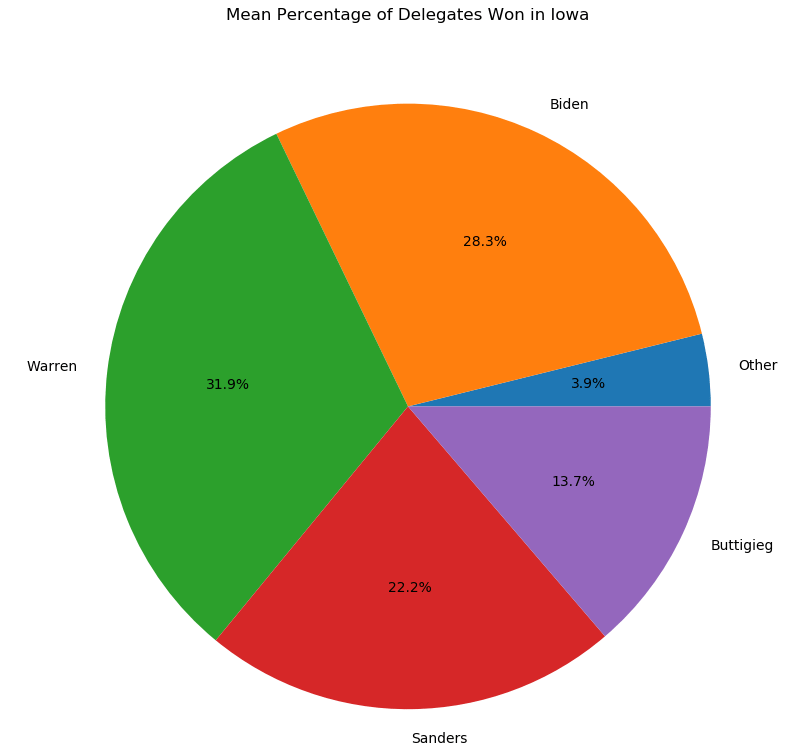
Further complicating matters is the system of delegate allocation, with just 14 delegates being awarded based on the statewide popular vote, and the remaining 27 split between Iowa’s 4 congressional districts. Not only will the allocation be related to the candidates’ popularities in a non-linear manner due to the system of realignment and the 15% threshold, but some of the delegate allocation will be very approximate. Delegates afterall, are people, no candidate can win half a delegate, so the resolution of the system is very low. For example, the 4th congressional district has just 5 delegates, so candidates with very different vote totals could receive the same number of delegates. Furthermore, a candidate with only a few more votes than a competitor could just pip them to the post for an extra delegate, winning far more representation despite having similar vote totals. Currently, our model is predicting that on average, Sanders will win the caucus with 14 delegates. He will be followed by Biden with 12, Warren and Buttigieg with 6 each, Klobuchar with 2, and another candidate with 1, most likely Yang or Steyer. It is worth noting that these predictions come with a very high degree of uncertainty owing to the complexity of the process.
Media Narratives
This year, for the first time, Iowa will release 3 sets of results. Historically, Iowa simply released the number of delegates allocated to each candidate. However, this year, both the first preference totals and the votes after realignment will be released. It is entirely plausible that these metrics will not all be won by the same candidate, potentially resulting in 2 or even 3 candidates declaring victory tomorrow! Whether or not that happens, the media narrative regarding the results will guide the public interpretation of them. This is not trivial, it is the public interpretation of the Iowa results, especially in terms of tactical voting and changing perceptions of which candidates are electable, which makes Iowa so important. Essentially, it doesn’t help a candidate much to win 13 delegates instead of 12, what matters is whether or not CNN declares them the winner.
Typically, the winner in Iowa receives a substantial bump in the polls. This might be more complicated this year due to potential disagreement over who the “winner” is, but remains electorally crucial. The popularity boost the winner gains is usually greater if they were not expected to win, indeed it may be more useful to consider each candidate’s performance not against one another, but against the respective expectations of each candidate. Currently, the media narratives are effectively, as ever, following intelligent averages of the polls but not accounting enough for uncertainty. Hence Sanders is broadly expected to win a narrow victory over Biden, and Buttigieg has largely fallen out of media coverage. In fact, it is still perfectly likely that any of the top four candidates could win in Iowa, although Sanders does have the best chance. High expectations of Sanders could limit the boost he receives should he win, whereas the potential upside for Buttigieg is massive, something he is counting on given his weak national polling.
Finally, candidates for whom expectations are very low can gain in the polls simply by coming second or third, exceeding expectations. This is effectively what Klobuchar is banking on. With 3 different sets of results it is also plausible that multiple candidates will be clamouring to claim second or third place. As you can probably tell, this is all becoming rather confusing and far too complicated to fit into a typical TV news segment. The manner in which journalists navigate this sea of information, and the spin candidates put on the results, will have a profound impact on the remainder of the primary.


 RedvBlue Politics