Trumpism Is Not An Effective Electoral Strategy

Doug Jones is a solidly left wing Democrat who makes little effort to appeal to conservatives. Nevertheless, in 2017 he was able to win a Senate seat in Alabama, one of the reddest states in the nation.

In 2018, Democrats won the House popular vote by almost 9 points, and held on to Senate seats in Montana and West Virginia.

In 2019, Democrats took full control of the Virginia State Legislature after many years out of power.

In 2020, Donald Trump became the first President to lose re-election since George H.W. Bush was defeated by Bill Clinton in 1992.

In 2021, Democrats took control of the Senate.

On reflection, even Trump’s victory in 2016 was somewhat unimpressive. It’s very rare for any party to control the White House for more than 8 years at a time, and even so Trump lost the popular vote to one of the least popular major party nominees in history, and only just won the tipping point state and hence the Electoral College. In the end, the Trump era has been an electoral disaster for the GOP, going from full control of Federal Government in January 2017, to Democrats having full control just 4 years later. Now the Republican Party is facing an internal conflict over whether or not to retain Trumpism, and its decision could determine its electoral performance for the coming decade.

Fundamentally, the electoral Achilles ’ heel of Trumpism is that it caters exclusively to the base, passionate Republicans who are very positive about Trump. All of Trump’s actions, decisions, and rhetoric are aimed at this one group. But this group simply isn’t big enough. Trump’s approval rating currently sits at just 39%, fairly typical of his rating throughout his Presidency. But 39% is not enough to win an election, and in these same polls an average of 56% of voters say they disapprove of Trump’s Presidency. Trumpism demonstrates little ability to cater to moderates and persuadable voters, because it doesn’t consist of policies or arguments, it consists of emotion. Ultimately, Trumpism is the politics of resentment for those perceived to have better opportunities in life than yourself. In this politics of emotion, it seems to frequently become necessary to believe conspiracy theories to rationalise emotions such as hatred of top Democrats or distress regarding election results. But the vast majority of the public don’t support these theories, so unless you already feel what you need to feel to buy into Trumpism, there really isn’t much out there to convince you to vote Republican right now.

Nothing represents this better than the failure of the GOP to publish a new manifesto in 2020, the first time a major party has missed a manifesto in decades. Instead, Trump chose to reuse his 2016 manifesto, which contains various outdated policies and ideas and is of course absent of any policies regarding Covid-19. Then again, having no policies regarding Covid-19 is reflective of a President who has sought to avoid engaging with the issue, instead focusing on attacking his critics online and hosting rallies, once again playing on emotion rather than policy. Entertainingly, this document which the GOP came to embrace in 2020 also contains various direct criticisms of “The President”, referring to Obama in 2016 but now reading as though Trump were attacking himself: “The President has been regulating to death a free market economy that he does not like and does not understand. He defies the laws of the United States by refusing to enforce those with which he does not agree”. The laziness of copy and pasting the manifesto verbatim is symbolic of Trumpism’s lack of interest in the actual process of governing a nation.

Furthermore, we see that Trump himself performs worse than other GOP nominees, and that the greater distance Republicans have from the White House, the better they do. In 2020, Trump lost the popular vote by 4.5 points, but the GOP only lost the House popular vote by 3. Based on the State Legislative seats which went up for election in 2020, we estimate that if every seat had gone up for election, Republicans would actually have won the State Legislative popular vote by 1 point. In the House and Senate, the Republicans who performed best as compared to Trump were consistently those who most frequently vote against him in Congress. This has a major impact in elections, with all 4 Democratic Senate gains made against Republican incumbents who voted with Trump 80-95% of the time despite being from competitive states.

On the other hand, it’s not entirely clear what strategy Republicans could employ other than Trumpism. Both the moderate and calm McCain in 2008 and the traditional conservative Romney in 2012 suffered clear defeats. The last time the Republicans won the Presidential popular vote was in 2004, but George W Bush went on to become a deeply unpopular President with a stained legacy, so his strategy is hardly one Republicans wish to replicate. Before that, Republicans have George H.W. Bush’s victory in 1988 to look to, except that he was defeated convincingly by Clinton just 4 years later. Therefore the GOP has to look a full 40 years into the past to Ronald Reagan and his “Reaganonomics” to find any proven electoral strategy for conservatives. The GOP’s identity crisis is certainly severe, but lacking any policies or recent examples of successful strategies, it seems overwhelmingly likely that the Republican party will end up stuck with some degree of Trumpism, and all the electoral challenges it entails.

What Biden’s Win Means For The Political Landscape

After months of voting, counting, and waiting, the General Election is finally over, and it’s bad news for Republicans. In the end, Biden won the popular vote by a fairly convincing 4.5 point margin. This is substantially less than what most opinion polls were predicting, but was still just enough to bring Biden to a victory. Not only did Democrats win back the key swing states of Pennsylvania, Michigan, and Wisconsin, they also picked up Ariziona and Georgia from the Sun Belt, both of which are extremely promising states for the party moving forward. However, in a sense Biden’s margin of victory was quite narrow, as he won the tipping point state of Wisconsin by just 0.6 points, meaning that Trump’s Electoral College advantage was approximately 4 points. Republicans also seem to be solidifying their control of Florida and North Carolina, quashing Democrats’ hopes in these populous and fast growing states.

In the Senate, we expected many of the key races to be close. In the end, many of these toss-ups ended up going to Republicans, continuing the trend we see in these results of Democrats underperforming their polls. The GOP held on in North Carolina and Iowa, and unseated Doug Jones in Alabama, demonstrating once again that incumbency is worth much less than party identity in the current political paradigm, making it extremely difficult for Democrats to hang on in red states and vice versa. Indeed, the vast majority of Senate seats once again simply went to the same party that won the Presidential race in that state. Democrats benefited from this trend by picking up seats in Colorado and Arizona, as well as 2 impressive wins in Georgia, giving Democrats the majority in the Senate they so desperately needed. The sole exception to the rule was Republican Susan Collins in Maine, whose moderate reputation allowed her to clinch a narrow victory in a blue state.

The House was a major source of disappointment for Democrats. While polling indicated the party may enjoy slight gains, instead their majority has been shrunk severely. Those Democrats who remain are a fairly cohesive coalition so should still be somewhat effective, however House votes won’t be the sure thing they once were. Overall across Presidential and Congressional races, we called 98% correctly. Our incorrect calls were all cases of underestimating Republicans, primarily based off inaccurate opinion polling.

Overall, this is a huge win for Democrats. With control of Congress and the White House, they will be able to pass Covid relief bills, implement executive orders, and appoint cabinet secretaries and justices as they please. However, their slim majorities in Congress will likely prevent them from implementing anything radical, as even a couple of Blue Dog Democrats voting against a bill would be enough to block it entirely. Furthermore, they are likely to lose those majorities in the 2022 midterms, meaning they will need to use these 2 years very effectively before Congress becomes split and deadlocked once again.

This election also serves as a vindication of the establishment wing of the Democratic party, demonstrating that mainstream left wing politicians are in fact capable of beating Republicans. This could put the brakes on the Progressive wing of the party, who had previously been arguing that only a radical populist Democrat could excite voters enough to win. It seems likely that in 2024, the Democrats will nominate Biden or Harris for the Presidency, with AOC or any other successor to Bernie Sanders sidelined. Conversely, the GOP may be forced to rethink its strategy. A President failing to win re-election is unusual, as is losing a Senate majority within just 4 years. Whether Republicans stick with Trumpism or fall back to the traditional conservatism of figures such as Mitt Romney will be enormously impactful, and doubtless a major political conflict over the next 4 years.

Finally, Republican structural advantages were cemented and expanded this election, most notably in Trump’s 4 point advantage in the Electoral College, increased from 3 points in 2016. It is entirely possible to envision a scenario where in 2024 or 2028 the Republican nominee wins the Electoral College despite losing the popular vote by 5-10 million ballots. Additionally, the GOP did surprisingly well in State Legislative races, giving them extensive control of the redistricting process coming up in 2021. Meanwhile in many of the states that Democrats do control, they allow the redistricting to be carried out by independent commissions. Ultimately this is likely to mean that Republicans continue to have significant structural advantages in elections for the House and State Legislatures for the next 10 years counterbalancing Democrats’ larger coalition.

Joe Biden Has A 92% Chance Of Winning The Presidency

This year our Presidential forecast model heavily favours Joe Biden to win the 2020 election, in one of the most high turnout elections in American history. Currently leading the national opinion polls by 9 points, and ahead in states with a total of 351 electoral votes, at this stage Biden losing the election would be a significant surprise.

Trump commands a safe lead in 125 electoral votes worth of states (AK, ID, MT, WY, UT, ND, SD, NE, NE-1, NE-3, KS, OK, MO, AR, LA, MS, AL, SC, TN, KY, IN, WV) as compared to Biden’s 216 safe electors (WA, OR, CA, CO, NM, HI, IL, VA, NY, VT, NH, ME, ME-1, MA, RI, CT, NJ, DE, DC, MD). That means that for Biden to win, he needs just 54 electoral votes from the pool of 197 electors across competitive states.

His easiest set of opportunities are in the Upper Midwest, where Trump is 9-10 points behind in Minnesota, Wisconsin, and Michigan, which together have 36 electoral votes. Winning here would require Biden to win back non college-educated white Obama-Trump voters, which by all accounts he appears to be doing. A recent surge in Covid-19 cases in this region (especially Wisconsin), combined with Trump’s terrible approval ratings on the handling of the pandemic, is likely to shore up Biden’s odds in these states.

Biden’s next easiest opportunity is in Pennsylvania with its 20 electoral votes, where he leads by 6-7 points. Pennsylvania is very likely to be the tipping point state this election, playing an absolutely pivotal role. If Biden wins in Minnesota, Wisconsin, Michigan, and Pennsylvania, he wins the Presidency without having to push any further into Republican territory. Our model gives Biden an 88% chance to win The Keystone State, which is a major contributing factor to his lead in our overall forecast.

Although Biden doesn’t strictly need any more targets, in electoral terms it’s generally wise to have backups. If something goes wrong for Biden in Pennsylvania or the Upper Midwest, he could well be rescued by the Sun Belt States. These are Florida, North Carolina, Arizona, and Nevada, which together have 61 electors and represent a more racially diverse cross-section of the population, requiring Biden to excel with groups other than non college-educated white voters. Courtesy of continued strong support from racial minorities as well as improving numbers with older white voters, Biden leads in each of these states by 4-6 points. These states therefore represent a generous cushion for the Biden campaign, and could plausibly decide the election in his favour were he to underperform with white Midwestern voters, but have a strong performance among minority ethnic groups.

Going one step further, Biden has several plausible long shot targets, namely Georgia, Ohio, Iowa, and even Texas. Together these have 78 electoral votes, with Biden and Trump approximately tied in polls in each state. To some extent, states this red have limited relevance in determining the outcome of the election. However, their high number of electors mean that in the event of  Biden victory, they will have a significant impact on the margin of victory in the Electoral College, playing a key role in shaping public perception of the outcome of the election, which could shape both major parties post 2020.

Overall, the current state of the race is bleak for President Trump, however the 8% chance of victory he has in our model is not to be disregarded. It’s important to remember that the President continues to have an Electoral College advantage, such that although national polling may have Biden ahead by 9%, he is only 6-7 points ahead in the most likely tipping point state.

Additionally, it’s worth remembering that polling is not an exact science, and that both random and systematic errors are perfectly common. In 2016, pollsters did not weight polls according to education level, resulting in non college-educated voters being underrepresented in samples which led to a 3 point underestimation of Trump, which was even more extreme in several swing states with large non college-educated white populations. In 2018, pollsters did weight by education and were very accurate indeed, so there’s no particular reason to expect a similar error this year as the problem seems to have been adequately addressed. However, it’s entirely possible that there may be a different systematic polling error, a possibility which our model does account for. If there is such an error, there is no particular reason to believe that it will favour Trump instead of Biden, such that a landslide for Biden is an entirely realistic possibility. Furthermore, even if we did see a 2016 style polling error which underestimated Trump by 3 points nationally and more in several swing states, Biden would still win the election. Biden’s lead is simply much larger than Clinton’s was in 2016, so for Trump to win as the result of a polling error we would have to see a truly historical systematic error across the polling industry.

The other mechanism by which Trump could remain President is via successful large scale voter suppression or vote manipulation attempts. Our model explicitly does not account for these, although it does take into account the normal levels of voter suppression which have been present throughout the nation for a long time. It’s very difficult to gauge what the probability of this happening is, but what you certainly can expect is extensive legal battles, delayed vote counts, and an extremely unusual election night. This year it’s going to be sensible to be patient, and voters will not necessarily know who has won the Presidency by the end of the night. Sticking to reliable, nonpartisan news sources and being aware of the fact that enormous amounts of disinformation are present are going to be critical to surviving the next week with our collective sanity intact.

Democrats Are Likely To Win Full Control Of Congress

With the 2020 General Election just a few days away, Democrats command convincing 9 point leads in both the generic ballot and Presidential opinion polling. Although Republicans have structural advantages in the House, Senate, and Electoral College, the size of the Democratic lead results in a grim outlook for the GOP this cycle.

Our probabilistic forecasts for the House, Senate, and Presidential races are complete and have been tracking the changing national environment over time. Since the first Presidential debate and Trump’s subsequent coronavirus diagnosis, the President lost the small gains he achieved following the Republican National Convention. This article explores our current forecasts for the House and the Senate. Although these might not be the most high profile contests this year, they are absolutely pivotal in determining whether the winner of the Presidential race will be able to govern effectively, or will simply be a placeholder keeping the next President’s seat warm for four years.

The House of Representatives

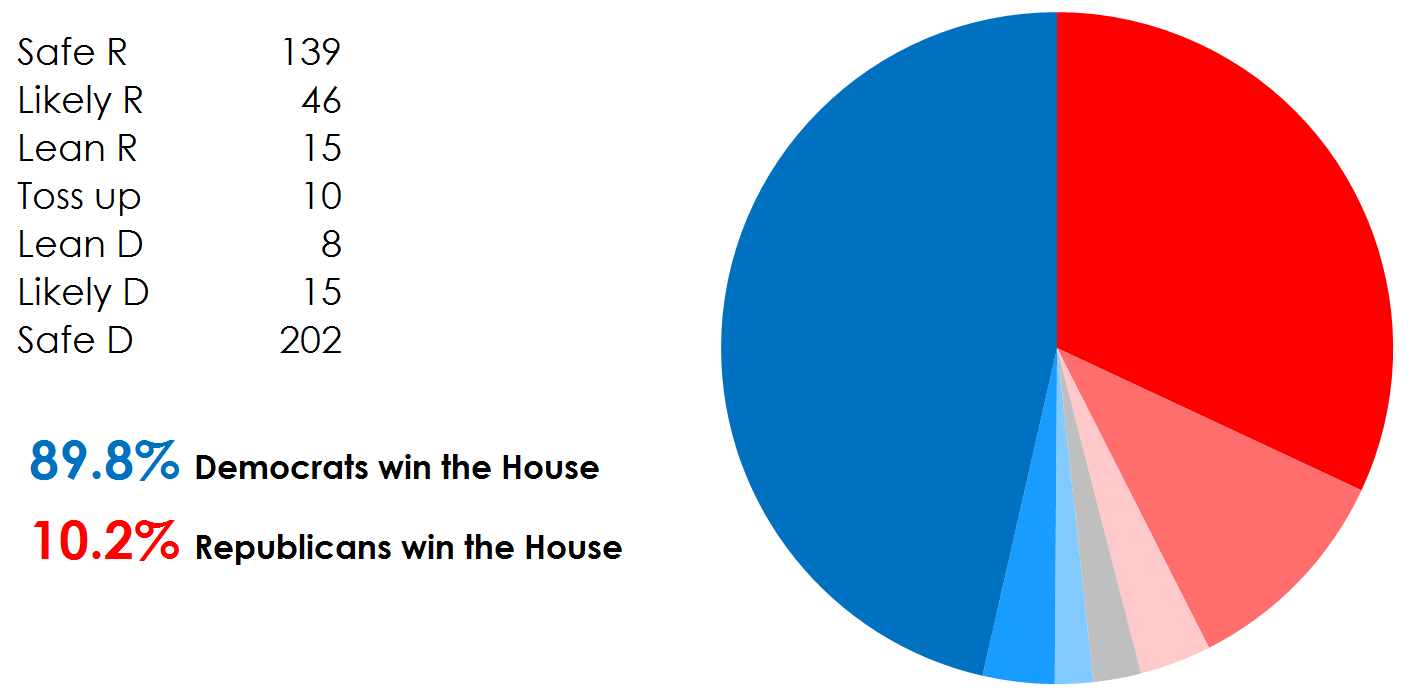
Following their blue wave in 2018, Democrats go into this year’s House elections with 232 representatives, a comfortable majority. To regain control, Republicans need to make extensive gains in an environment even more favourable to Democrats than the 8.5 point lead they enjoyed in 2018. Additionally, Democrats now have the advantage of incumbency in almost every swing seat, having won them off Republican incumbents 2 years ago. As a result, our model gives Democrats a 98% chance of maintaining control of the House, and actually expects them to expand their majority, winning 240 seats on average.

The Senate

In a chamber where California gets the same number of representatives as Wyoming, Democrats are always going to struggle. The Republican structural advantage in the Senate is immense, such that even in 2018 Republicans were able to expand their majority, and now occupy 53 out of the 100 seats. However, in 2018 Democrats had very high exposure in the Senate, with the vast majority of the seats up for election that year occupied by Democrats. This gave the GOP plenty of chances to pick off some of the less secure Democrats in red states they’d won courtesy of excellent years for Democrats in 2006 and 2012. In 2020, the tables are turned as the GOP seeks to hold onto the gains it made in 2014. Now Republicans have high exposure, and could suffer significant losses in this very blue national environment.

12 Democratic and 23 Republican seats are up for election this year, including many Republican held seats in moderately red states. To win control Democrats need to make a net gain of 3 or 4, depending on whether Kamala Harris or Mike Pence is elected to the Vice Presidency, which breaks ties in the Senate. The GOP stands to make a fairly easy gain unseating Doug Jones in Alabama. Following his victory in one of the reddest states in the country as a result of facing an exceptionally unpopular opponent in Roy Moore, Jones has been voting consistently with the Democratic mainstream. It appears he decided that even if he voted as a conservative Democrat in a similar manner to Joe Manchin in deep red West Virginia, Jones would still lose his re-election campaign, so has simply been voting with his party. The only other Republican target is Michigan, where Democrat Gary Peters is facing a small threat to his re-election campaign, but will probably pull through given that Peters and Biden are both consistently leading polls in the state.

Given Biden’s lead in national polling, it’s reasonable to assume that Democrats therefore need to make approximately 4 gains to win control of the Senate. Colorado is an obvious target, Biden is leading there by 14 points and incumbent Cory Gardener has made little effort to appeal to moderates in the state, and trails in polls by a significant margin. If Democrats can’t win this one, they can’t win.

Arizona presents a second strong target for Democrats. This swing state is currently leaning towards Biden, and the Republican incumbent Martha McSally is only an appointed incumbent, not an elected one, and is therefore not expected to command a significant incumbent advantage. Interestingly, in 2018 McSally lost Republican Jeff Flake’s old Senate seat to Democrat Kyrsten Sinema, so if McSally loses again this year she will have been responsible for the GOP losing both Arizona Senate seats in the space of 2 years!

Beyond these 2 targets, Democrats have to work harder to make gains. Maine is a slightly blue state, but incumbent Republican Susan Collins has a moderate reputation, putting her in a much stronger political position than Gardener or McSally. However, since voting in favour of confirming Brett Kavanaugh to the Supreme Court, voters in Maine are increasingly questioning her moderate reputation. She trails slightly in polling, but this is a race that could easily go either way.

Iowa and North Carolina are each somewhat red states with Republican incumbents, so the fact that Democratic challengers have small leads in each of these states is a reflection on the national political situation being very favourable toward Democrats. Additionally, Democrats are only slightly behind in Montana, Kansas, Arkansas, South Carolina, and both races in Georgia. All of these are red states with Republican incumbents, the fact that Democrats are even in contention here must be alarming for the GOP.

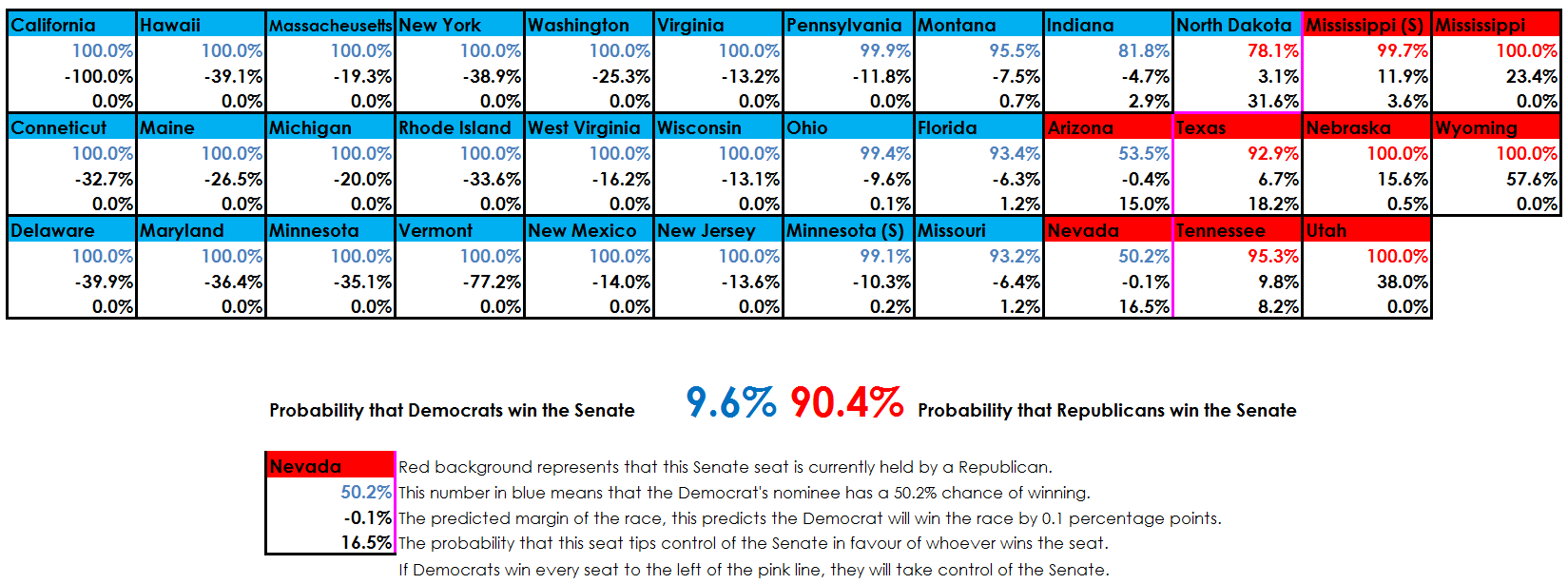
All in all, Democrats have 2 easy opportunities to make gains, and 9 highly competitive races which could go either way. If Democrats win even just a couple of those, they win the Senate. That’s why our model gives Democrats an 81% chance of taking control of the upper chamber. An important note is that the margin could also be extremely important here. If Democrats have only 50 Senators, they would be reliant on conservative Democrat Joe Manchin, whose vote could not be counted on for any liberal policies. If Democrats have 52 seats things are very different, and if Biden were President he could probably pass mainstream Democratic reform through Congress easily. With 55 seats or more, Democrats could run rampant passing whatever progressive policies they so choose, so truly every single competitive race could have an immense impact on politics going forward.

Whilst this piece has focused on the more likely scenario of Democratic victory, it’s worth emphasising the fact that the 2% and 19% chances of Republicans winning the House and Senate respectively are real and should not be ignored. But to hold on even in just the upper chamber, the GOP has a lot of ground to make up. Aside from Susan Collins, Republicans in key races show very limited interest in using moderate rhetoric and policy positions to persuade Independent voters, leading Independents to overwhelmingly back Democrats. While passionate conservative messaging does encourage Republican turnout, it also fires up Democratic turnout, such that Republicans find themselves having to play defence deep within their own territory. If the GOP does indeed suffer a severe defeat this year, they may have to re-examine this strategy.

Biden’s Lead Is Significant, But Fragile

With the 2020 Presidential election less than 3 months away, high quality polls are being published in large numbers, giving us a clear understanding of the current state of the race. To help sort through this mass of data, we’ve calculated polling averages in all 50 states, DC, and the nation as a whole. These averages take into account the sample size and type of each poll, and each pollsters’ past performance. In states where few polls are conducted, the data used to generate the polling average is supplemented with the national polling average plus the base partisanship of the state.

West Virginia Trump +23.0
Wyoming Trump +20.5
Nebraska 3rd Congressional District Trump +19.2
Oklahoma Trump +17.8
Kentucky Trump +15.1
North Dakota Trump +14.7
Alabama Trump +14.5
Utah Trump +11.2
Idaho Trump +11.2
Tennessee Trump +9.0
Nebraska At Large Trump +8.2
Indiana Trump +8.0
Kansas Trump +8.0
South Dakota Trump +7.9
Montana Trump +7.4
Mississippi Trump +5.7
South Carolina Trump +5.2
Louisiana Trump +5.0
Arkansas Trump +4.5
Nebraska 1st Congressional District Trump +4.3
Missouri Trump +3.7
Alaska Trump +3.0
Texas Trump +0.5
Iowa Trump +0.2
Georgia Trump +0.2
Ohio Biden +1.2
Maine 2nd Congressional District Biden +2.5
North Carolina Biden +2.7
Arizona Biden +3.9
Nebraska 2nd Congressional District Biden +5.2
Florida Biden +5.6
Pennsylvania Biden +6.6
Wisconsin Biden +7.3
USA Biden +7.7
Minnesota Biden +8.0
Michigan Biden +8.2
Nevada Biden +8.3
New Hampshire Biden +9.7
Virginia Biden +10.0
Maine At Large Biden +11.4
Colorado Biden +12.0
Oregon Biden +12.3
New Mexico Biden +12.6
Illinois Biden +14.5
Delaware Biden +14.9
Rhode Island Biden +16.7
New Jersey Biden +17.6
Connecticut Biden +18.0
Washington Biden +20.6
Maryland Biden +21.7
New York Biden +22.3
Vermont Biden +22.9
Maine 1st Congressional District Biden +23.0
Hawaii Biden +26.3
Massachusetts Biden +26.4
California Biden +27.7
District of Columbia Biden +51.9

Biden Leads Nationally And In Swing States

Clearly, these numbers paint a very optimistic picture for Biden, with a 7.7 point national lead. This is a larger lead than Clinton enjoyed at any stage of the 2016 campaign. Additionally, Trump is behind in key swing states, with Biden up 5.6 in Florida, 6.6 in Pennsylvania, 7.3 in Wisconsin, and 8.2 in Michigan. That said it is essential to remember that systematic polling errors do regularly occur. We therefore recommend you expect these averages to be up to 3 points off in either direction. Even with this degree of uncertainty, Biden looks comfortably ahead. His lead only becomes more apparent when the averages are plotted in Electoral College terms as shown in the chart below. Trump is ahead in states worth only about a quarter of the electoral votes, and behind in states worth two thirds, with the remainder being toss-ups.

Pie10Aug

The states in this chart are plotted in order of how well Trump is polling, with his biggest lead being in West Virginia, and his lead in each state diminishing clockwise around the chart. The state at the direct bottom of the circle (6 o’clock) is then the “tipping point state”. This is a term used for the state which provides the winner with their 270th electoral vote. Clearly there is some uncertainty, but at the moment it looks likely that the tipping point state will be one of Wisconsin, Pennsylvania, or Florida. These are therefore the most important states to be watching to determine who is going to win the election. In each of these states Biden’s edge is smaller than his national lead. This difference is Trump’s Electoral College advantage, which currently looks to stand at approximately 1.5 points. That means that Biden would need to win the national popular vote by at least 1.5 points to be the favorite to win. 1.5% is smaller than Trump’s 2.5% structural advantage in 2016, reflecting Biden’s strength as compared to Clinton with non college educated whites who dominate Midwestern swing states.

This Is A Snapshot, Not A Forecast

A crucial point to note is that these are simply polling averages reflecting current public opinion. The election is still quite some time away, leaving ample opportunity for the polls to shift. If the election were tomorrow, it would most likely be a landslide victory for Biden. The possibility that public opinion could change over time is what gives Trump a real shot at winning re-election. At this stage there are still plenty of major events that could swing the election, such as Biden selecting a Vice Presidential nominee (probably Kamala Harris), party conventions, and of course several debates.

There is also an argument to be made that this year public opinion could be more volatile than usual. Sharp shifts in the economy and the Covid-19 situation have already caused polling to fluctuate, and will likely do so again before November, potentially benefiting Trump or Biden significantly. On the other hand, one could argue that in these hyper-partisan times there are few people who are seriously going to change their minds, particularly as almost everyone in the country already has a strong and deeply ingrained opinion of the President one way or the other. So far, national polling has only varied between Biden +6 and Biden +10, with almost no good polling for Trump seen to date.

Overall, it is clear that the national environment remains about as favorable to Democrats as it has for the past 3 years, with Republicans consistently underperforming by 7-9 points. The fact of the matter is that currently the Democratic base is larger than that of the GOP, and most Independents are choosing to vote blue. For Trump to have a serious shot at re-election, something substantial is going to have to change.

Confusion As Iowa Results Delayed

Do you find the Iowa caucus system confusing? Don’t worry, so does the Iowa Democratic Party. It’s the morning after and there are still zero official results. Instead, we have chaos. The Party has failed to provide a thorough or consistent explanation for the absence of results. Reports from Iowa suggest that pretty much everything that could have gone wrong, has.

The key issue seems to be technical problems with an app precincts use to report their results. The technical helpline provided for this app is overloaded, with hold times of more than an hour and some callers being hung up on as soon as they get through to a technician. The backup system for reporting results, based on phone calls, also appears to have collapsed. Additionally there are reports of widespread confusion at caucus sites regarding the process itself, including among some organisers as a result of changes in the system since 2016.

Nevertheless, both the Buttigieg and Sanders campaigns have effectively declared victory, citing anecdotal reports from their own representatives at limited numbers of precincts, and unofficial preliminary results from <2% of precincts from the AP. Meanwhile the Biden campaign is casting aspersions on the legitimacy of the process, perhaps pre-emptively making excuses for what could have been a disappointing night for Biden. The President is also jumping in, insinuating that there exists a conspiracy in Iowa to manipulate the election results. This is one of many misinformation campaigns, with another example being the widespread retweeting of a report of Biden dropping out of the 2008 race, attempting to pass it off as being about 2020.

This is a disaster for Iowa, calling into question the caucus system and Iowa’s traditional position as first in the primary calendar. If Iowa were to switch from a caucus to a primary system, it would fall victim to a New Hampshire state law requiring the state to always have the earliest primary. This year, we can expect Iowa’s influence to be significantly decreased due to the confusion and mixed messages. This is probably good news for Biden, who was comparatively weak in Iowa, and disastrous for candidates such as Buttigieg and Klobuchar who built their entire campaigns on winning Iowa. We could now see New Hampshire become the most important state in the primary, and the power of Nevada and South Carolina magnified dramatically. Sanders particularly could stand to benefit due to his strength in New Hampshire, but this is uncharted territory, so the exact impact of tonight’s debacle is unpredictable.

For now, we recommend that you don’t take any of the currently available data seriously. Entrance polls, photos of caucuses, campaigns releasing their own biased estimates, and preliminary results from a tiny proportion of precincts are all very weak data points. We are going to have to wait for the final, official results. Thankfully, there is a paper trail for the caucuses. Therefore, if the worst comes to the worst, the Party can painstakingly recount every vote and eventually arrive at accurate, reliable results. Campaigns have been told that results should be released later today, but at this stage there’s really no telling whether or not that will happen.

What The 2019 Election Results Do and Don’t Tell Us

The votes are in, and the headlines are big wins for Democrats in Virginia, where they took full control of state government, and Kentucky, where they overcame partisanship to win a gubernatorial race in one of the reddest states in the country (albeit by just half a point). But Republicans did manage to hold on to full control in Mississippi, and conservatives saw some success in ballot measures. Naturally there are already a huge variety of hot takes on what this all means, let’s break the main ones down one by one.

This was a good night for Democrats

True. Across the board, Democrats significantly overperformed the partisanship of their districts and states by an average of 5 points, with that advantage rising  to about 9 points in races with no Republican incumbent. These figures approximately match other indicators of the mood of the electorate, such as the congressional generic ballot showing Democrats 6-7 points ahead. Additionally, polls pitting theoretical Democratic Presidential nominees against Trump show 5-7 point leads for Warren and Sanders, with Biden holding an even greater lead. All in all Democrats can rest easy that the national environment is distinctly blue, although not quite as blue as it was in 2018, when Democrats won the House popular vote by 8 and a half points. Furthermore, Democrats and left-leaning Independents are clearly highly motivated, displaying very high turnout for an odd year election. In future analysis we should be operating with the prior assumption that something significant has to change before Republicans can dream of winning the popular vote.

The results show Trump will lose re-election

False. Elections this far away from Presidential races simply are not good indicators of voting intention so far in the future. For example, Democrats suffered heavy electoral defeats throughout Obama’s first term, yet he went on to win re-election fairly comfortably. With Trump himself on the ballot, perhaps Republican turnout will rise to match that of Democrats. Or maybe Democrats will fail to convince the nation that Trump should be impeached, yet still go ahead and impeach him. The Democratic nominee could be perceived negatively, perhaps for extreme left wing positions in Warren’s case, or old age in Biden’s. And don’t forget the Electoral College which in 2016 gave Trump an advantage of about 2 and a half points, and the political wisdom that incumbent Presidents typically win re-election. If anything, the takeaway here is that 2020 will be very competitive.

2020 turnout will be at a record high

True (probably!) We’ve now seen exceptionally high turnout in both 2018 and 2019, with many of last night’s elections showing higher turnout than the 2014 midterms. All the data points suggest a deeply politically engaged electorate who are keen to come out and vote, especially for or against the President. Healthcare, immigration and gun control also appear to motivate voters a great deal, and there will be enormous contrast between Democratic and Republican policy on all three of these issues, regardless of who Democrats nominate. 2020 turnout in excess of 70% (compared to 55% in 2016) is entirely plausible. Who this would benefit is another question. Ethnic minorities and young voters are the traditional low turnout demographics. If increased electoral engagement is driven by these groups then Democrats could be at a big advantage. That said, every demographic has room for turnout to increase substantially. This is a case where the details are everything.

Split ticket voting is alive and well

False. Sure, Kentucky voted for a Democratic governor, yet voted against Democrats down the ballot by margins of around 20 points. But this really was an exceptional case, on par with Roy Moore’s ill-fated 2017 bid for an Alabaman Senate seat. Matt Bevin was the least popular governor in the country, with a net approval rating of about -25, and a net approval of only +11 points among Republicans. He won just 52% of the vote in his primary and is infamous for putting both of his feet in his mouth at once, for example when he “guaranteed” that children in Kentucky were being sexually assaulted as the result of a teacher strike. Overall in recent elections there is very little evidence of significant ticket splitting, and in 2020 we should expect the vast majority of voters to vote the same way in all races.

Mitch McConnell’s re-election is at risk

False. We can be fairly sure that the Senate Majority Leader won’t be losing his seat in 2020. He is certainly a remarkably unpopular senator given the partisanship of Kentucky, with approval ratings comparable to those of Bevin. But the crucial difference is that McConnell is up for re-election in a presidential year. All the media attention will be on the presidential race, and Trump’s presence at the top of the ballot will help out any struggling Republicans in red states. In 2016, every state voted the same way for the Presidency and the Senate. In 2018, we saw further evidence that party identification is becoming a much more important factor than the specific person running for office, especially in federal races. We should therefore continue to assume that so long as Kentucky is safe for Trump, it’s safe for McConnell.

One last thing: Democrats now control the entire Virginian legislative and executive branches, will they seek to aggressively gerrymander Virginian seats in their favor? Before they came into power in the state, Democrats vigorously supported a bill seeking to create an independent redistricting commission. That bill has now made quite a bit of progress, but its successful passage would prevent Democrats from capitalizing on their gains in 2019 to draw maps designed to elect as many Democrats as possible. So the question is, will they hold fast to their established anti-gerrymandering position, or will 10 years of massive electoral advantages be too great a temptation to resist?


Is The Electoral College Racist?

Back in August, Rep. Alexandria Ocasio-Cortez posted an Instagram story criticizing the Electoral College, calling it “a scam”. She went on to claim that “the Electoral College has a racial injustice breakdown. Due to severe racial disparities in certain states, the Electoral College effectively weighs white voters over voters of color, as opposed to a ‘one person, one vote’ system where all our votes are counted equally.” Unsurprisingly, her comments faced severe criticism from the right, which railed particularly strongly against the accusation that the Electoral College is racist.

So is it true that this institution makes white votes more powerful than others? Well, this is something we can test. We ran fifty-thousand simulations of presidential elections featuring a generic Republican facing down a generic Democrat. From these, we determined how much of a swing state each state is, and multiplied by their number of electoral votes to create a rating of how powerful each state is in presidential elections. Dividing this rating by the number of voters in the state gives us an index of how powerful each individual vote is. But this isn’t the full picture.

The concept of “wasted votes” is the main metric being used to assess gerrymandering today, that being the practice of drawing district boundaries to the benefit of one party over the other. Two techniques are used to achieve this: “Packing” and “cracking”. Packing is where you draw a district to lean as strongly as possible in favor of one party, packing all their voters into this one district such that the party is far less competitive in every other race. Cracking is where you spread a party’s voters out evenly between many districts such that they make up 40-45% of the population in every race. Therefore even though that party’s voters may make up almost half the population, they win none of the elections.

In the below example, green voters have been packed into one district and cracked across the rest, resulting in the purple party winning 5 out of 6 elections despite having only as many voters as the green party.

Gerrymandering Example

The wasted votes system counts any votes cast for a losing candidate as wasted. Therefore if most elections are being won by the same party by small margins, a huge number of the other party’s votes will be judged as wasted, effectively detecting cracking. Additionally, votes cast for the winning candidate above the 50% they need to win the election are also judged as wasted. This detects packing, as if a candidate wins a huge proportion of the vote, a large number of their votes will be wasted.

Applying this to our analysis has a profound effect on the results, leaving only the votes that make an impact on the election. For example, Republican votes in Upstate New York are discounted as these Republicans are not represented at all in the Electoral College. Additionally, many Democratic votes used to build up enormous margins in New England are treated as wasted as you don’t get any more electors for winning by 30% than by 1%. This leaves us with a clear picture of which votes count, and how much they count for. By studying the race of each voter, this information is used to calculate the average power associated with a white, black, Hispanic, and Asian vote.

The results of this are striking. On average, white votes are worth 1.13 times the average vote. Black and Hispanic votes are each worth 0.81 times the average, and Asian votes just 0.75 times. This can be attributed to a few factors. Firstly, the all important Midwestern swing states (Michigan, Wisconsin, Ohio, Pennsylvania, Minnesota, Iowa) are disproportionately white. Also, many non-white voters are packed into big cities in safe Democratic states like California, such that many of their votes are wasted running up the score in landslide elections. Additionally, many black voters are “cracked” across the South, forming large minorities which can never muster up quite enough votes to win the state.

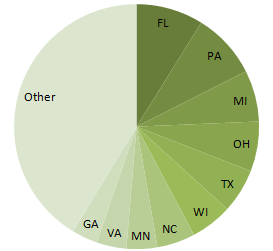
To understand better how the disparity in representation arises, we can look at which states are the main sources of each race’s voting power. White voters are fairly evenly distributed, so the breakdown for white voters shows the main sources of their voting power being the key swing states around the country, the only surprise being the increasingly competitive Texas.

W

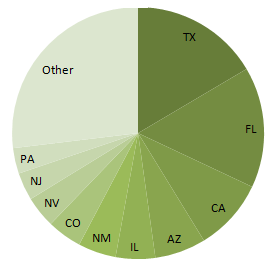
By contrast, black voters are much more concentrated in the South, and so their voting power is much more dependent on Florida, perhaps the only really competitive Southern state. However black voters are also able to exert their influence in Virginia, where since the Obama era they have formed the basis of a slim but surprisingly sturdy Democratic majority. Georgia and North Carolina also score highly as a result of large ethnic minorities coming increasingly close to flipping these states in what would be a major coup for Democrats. Interestingly, large black populations in Alabama, Mississippi, South Carolina, Louisiana and Tennessee wield very little power in the Electoral College as they almost all vote Democrat, but these states never go blue.

B

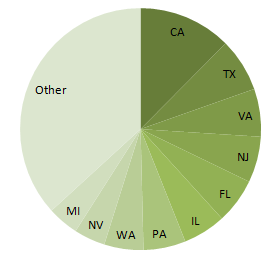
Hispanic voting power is even more concentrated, with five states providing over half their electoral influence. Texas and Florida each provide 16% of their voting power, with most of the key swing states having only small Hispanic populations. The importance of their role in Texas cannot be overstated. Although the Texas GOP may lose Hispanic voters by large margins almost all the time, the fact that these margins are closer to 50 points than 90 means Republicans are still able to win in this racially diverse state. In other words, it doesn’t just matter whether you win or lose a demographic, the exact margin is crucial. Arizona, a new swing state, is another key source of Hispanic voting power, and is sure to be getting a lot of attention in 2020.

H

Finally, many Asian voters are packed into coastal cities in deep blue states, with very little presence in any swing state, resulting in their minimal electoral influence and the absence of any concerted efforts to win them over.

A

This analysis suggests that AOC is probably correct at least in her assertion that due to the Electoral College, white votes count for more than those of voters of color. There is also potential for this to be reversed in the future, as increasing non-white populations in Texas, Arizona, Florida, North Carolina and Georgia could make these states increasingly competitive, and perhaps even turn them reliably blue as has happened in Virginia. But for now, tens of millions of Americans are forced to live with the reality that their vote has little to no impact, and this disempowered group is disproportionately non-white.

What The Midterms Results Tell Us About Politics

The madness of the midterms is over, and the results are pretty much as expected, with Republicans building up their Senate majority but losing the House. In fact, of the races called so far, our model correctly predicted the overall results of 97.2% of them. We predicted a Senate result of 48 Democrats to 52 Republicans, very close to the probable final result of 47-53. The House model gave a similarly accurate prediction of 239-196, against the probable final result of 234-201. At first the night looked tough for Democrats, with mixed early results in Florida, a slight surprise in the defeat of Indiana Democratic Senator Joe Donnelly, and the defeat of Amy McGrath in Kentucky’s 6th congressional district. These early results seem to have played an outsized role in forming the narrative of the election, that of a good but still disappointing night for Democrats. But make no mistake, this was a blue wave. Democrats successfully competed in suburbs to win a solid majority in the House, won the popular vote by a wide margin (about 8 points), and did surprisingly well in the Senate given that this year’s map was very good for Republicans.

The next most significant takeaway is probably that incumbency matters much less than it has in the past. America voted along partisan lines to an unprecedented extent, with very little ticket-splitting. The highest profile casualties of this were Democratic Senators in the red states of Missouri, Indiana, and North Dakota. Even in Montana and West Virginia where the Democratic Senate incumbents won, they did so by surprisingly small margins, and in Florida, which isn’t even that red, Republican Rick Scott beat Democratic incumbent Bill Nelson. By the way, watch out for Rick Scott in 2024, a popular and seasoned Governor come Senator from a swing state, whose term is ending in a Presidential year, is definitely someone to be aware of when the rumours about who’s running for President start to circulate.

Next, voter engagement was off the charts, with a turnout of 49%, the highest midterm turnout since 1914! This isn’t even much lower than the 56% turnout for the Presidential race in 2016. Of course these numbers are still very low compared to most Western democracies, but if this trend holds it seems perfectly plausible that we see extraordinary turnout in 2020 when the fate of Trump’s Presidency will truly be in play, 70% turnout begins to seem perfectly possible.

Thirdly, healthcare is by far and away the most prominent issue in politics right now. Democrats built their campaign on protecting the healthcare system, and to some extent it drove their victory, as it seems to be an argument they are winning – in a recent poll, 44% of those sampled said they trusted Democrats more on healthcare, compared to just 34% for Republicans. The next most important issue was immigration, perhaps unsurprisingly given Trump making a migrant caravan in Mexico a prominent issue during the final days of the campaign. These were followed by the economy, then gun control. It’s likely that these are the issues that will shape the elections in 2020, as politicians can see the incredible extent to which they have engaged the public. An economic downturn could spell the end of the Trump Presidency, or continued growth could form the basis of his re-election campaign. And it seems beyond doubt that the Democratic nominee will make healthcare a major talking point, and bring it up as often as they can.

Thinking about 2020, 2018 taught us a lot about what the electoral map is going to look like in 2 years time. Minnesota, Michigan, Wisconsin and Pennsylvania all veered away from Republicans, while Democrats enjoyed little joy in the Sun Belt. The Sun Belt is a collection of Southern and South-Western states which lean Republican, but Democrats dream of turning blue by turning out large ethnic minorities. The Sun Belt usually means Florida, North Carolina, Arizona, and sometimes Georgia and Texas too for the more ambitious Democrats. The best path to victory for Democrats in 2020 is now clearly via the Upper Midwestern states, which gives extra weight to Joe Biden and Amy Klobuchars’ potential Presidential campaigns, as they both have proven ability to appeal to Midwestern voters. But don’t discount Beto O’Rourke. He may have lost, but in a way that’s good for him, he now has more time to build up his campaign infrastructure, visit the early primary states, and prepare for another battle. He lost by a surprisingly small margin of only 2.6 points, and managed to electrify and thrill the Democratic base in a way that no one has really done since Obama. Add that to extraordinary fundraising abilities, and you have a very very strong contender for the Presidency.

Final Midterm Forecasts

The election is now almost here, and the final RedvBlue forecast is interesting but overall fairly clear and decisive. The top line is that Democrats have about a 10% chance of winning control of both chambers of Congress. The Republicans have a similar chance of full control, and in the remaining 80% of cases, the Democrats will win the House, but the Republicans will hold onto the Senate.

Warning: The approximately 10% chance that Democrats win the Senate and the 10% chance that Republicans win the House are very real. This means that if the election ran a hundred times, we would expect these things to happen about 10 times each. This election is not a dead certainty, and elections are nothing if not surprising, so be prepared!

The Senate

4_11predictions

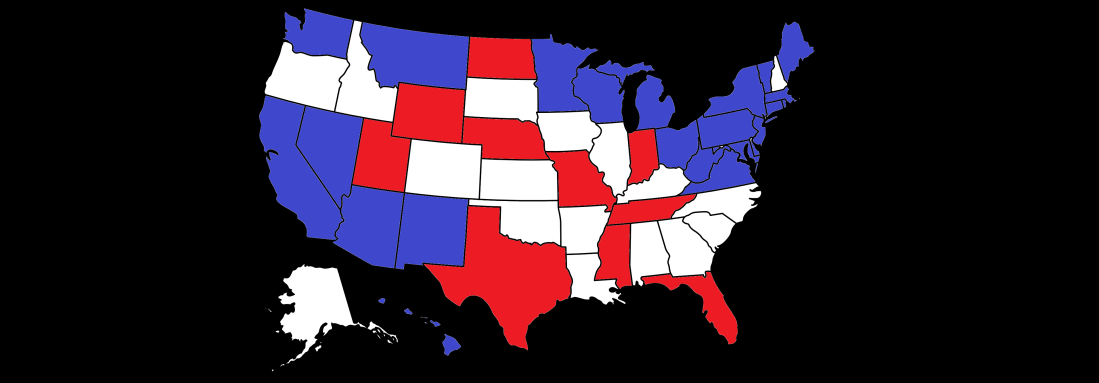
Republicans Ted Cruz and Marsha Blackburn of Texas and Tennessee respectively seem to have successfully fended off fierce challenges from Democrats, and are looking confidently ahead in the polls. The bad news for Republicans is that the Democratic incumbents in deep red states seem to have largely consolidated their positions. West Virginia and Montana look remarkably safe for Democrats, and though the model’s predictions in Missouri and Indiana are nowhere close to certain, the GOP seems significantly behind in both. Only North Dakota has proven vulnerable to Republican efforts to make gains, but this may very well be enough. The highly competitive races remaining in the Senate are Nevada, Arizona, and North Dakota, and Democrats need all 3 to win a majority. Nevada and Arizona are now almost perfect 50:50 toss-ups, it’s really anybody’s guess who’ll win those. But the two states are relatively similar, so it’s reasonable to imagine that they’ll both choose the same party. Meanwhile Democrats need Heidi Heitkamp to pull off a small miracle in North Dakota in order to secure the seat, which has been looking increasingly vulnerable as the election has progressed.

Due to tiny Democratic leads in Nevada and Arizona, going on a seat by seat basis the model predicts that the composition of the Senate will become 50-50, with Vice President Mike Pence giving Republicans the casting vote. But due to the high exposure of several red state Democrats, and very low exposure of the GOP, the average prediction given by the model is that Republicans will come out of the midterms with 52 Senate seats, against only 48 Democrats. The most likely scenario in which this happens would be that Republicans win in North Dakota, Nevada and Arizona.

The House

4_11predictions2

By contrast, the Republicans would need a small miracle to win in the House. Democrats need 23 gains to take control, and New York, California, and New Jersey put together provide almost enough competitive races to allow for that on their own. Democrats are looking great in the New York seats, and in California they’re assisted by there not even being a Republican on the ballot for the Senate race, potentially causing some Republican voters to not bother turning out. However, Democratic Senator Robert Menendez of New Jersey is looking unusually weak this year, having been caught up in a significant scandal, this might weaken Democratic chances across the state. But then there are simply so many other good options for the party to pick up the seats they need. Democrats are looking much stronger across the Midwest than they did in 2016, and Pennsylvania and Minnesota are both heavily laden with competitive districts. On a seat by seat basis, the model predicts the House will go 231-204 in favour of Democrats, representing a net gain of 36 seats. In the House it’s Republicans who are heavily exposed, so the average net gain predicted by the model is 44 seats, leading to a 239-196 House composition, a strong Democratic majority.

Predictions In Full

Here is a full list of our final calls. Although some of these races are toss-ups, this is who we think would win in each race if we had to choose.

Senate – Democratic Wins (Includes Independents who caucus with Democrats)

Arizona, California, Connecticut, Delaware, Florida, Hawaii, Indiana, Maine, Maryland, Massachusetts, Michigan, Minnesota, Minnesota Special, Missouri, Montana, Nevada, New Jersey, New Mexico, New York, Ohio, Pennsylvania, Rhode Island,  Vermont, Virginia, Washington, West Virginia, Wisconsin.

Senate – Republican Wins

Mississippi, Mississippi Special, Nebraska, North Dakota, Tennessee, Texas, Utah, Wyoming.

House – Democratic Wins

Alabama – 7
Alaska – none
Arizona – 1-3, 7, 9
Arkansas – none
California – 2, 3, 5-7, 9-20, 24-41, 43-49, 51-53
Colorado – 1, 2, 6, 7
Connecticut – 1-5
Delaware – at large
Florida – 5, 7, 9, 10, 13-15, 20-24, 26, 27
Georgia – 2, 4, 5, 13
Hawaii – 1, 2
Idaho – none
Illinois – 1-11, 14, 17
Indiana – 1, 7
Iowa – 1-3
Kansas – 2, 3
Kentucky – 3
Louisiana – 2
Maine – 1, 2
Maryland – 2-8
Massachusetts – 1-9
Michigan – 5, 8, 9, 11-14
Minnesota – 1-5, 7
Mississippi – 2
Missouri – 1, 5
Montana – none
Nebraska – none
Nevada – 1, 3, 4
New Hampshire – 1, 2
New Jersey – 1-3, 5-12
New Mexico – 1, 3
New York – 3-10, 12-20, 22, 25, 26
North Carolina – 1, 4, 9, 12
North Dakota – none
Ohio – 3, 9, 11, 13
Oklahoma – none
Oregon – 1, 3-5
Pennsylvania – 2-8, 17, 18
Rhode Island – 1, 2
South Carolina – 6
South Dakota – none
Tennessee – 5, 9
Texas – 7, 9, 15, 16, 18, 20, 28-30, 33-35
Utah – 4
Vermont – at large
Virginia – 3, 4, 7, 8, 10, 11
Washington – 1, 2, 6-10
West Virginia – none
Wisconsin – 2-4
Wyoming – none

House – Republican Wins

Alabama – 1-6
Alaska – at large
Arizona – 4-6, 8
Arkansas – 1-4
California – 1, 4, 8, 21-23, 42, 50
Colorado – 3-5
Connecticut – none
Delaware – none
Florida – 1-4, 6, 8, 11, 12, 16-19, 25
Georgia – 1, 3, 6-12, 14
Hawaii – none
Idaho – at large
Illinois – 12, 13, 15, 16, 18
Indiana – 2-6, 8, 9
Iowa – 4
Kansas – 1, 4
Kentucky – 1, 2, 4-6
Louisiana – 1, 3-6
Maine – none
Maryland – 1
Massachusetts – none
Michigan – 1-4, 6, 7, 10
Minnesota – 6, 8
Mississippi – 1, 3, 4
Missouri – 2-4, 6-8
Montana – at large
Nebraska – 1-3
Nevada – 2
New Hampshire – none
New Jersey – 4
New Mexico – 2
New York – 1, 2, 11, 21, 23, 24, 27
North Carolina – 2, 3, 5-8, 10, 11, 13
North Dakota – at large
Ohio – 1, 2, 4-8, 10, 12, 14-16
Oklahoma – 1-5
Oregon – 2
Pennsylvania – 1, 9-16
Rhode Island – none
South Carolina – 1-5, 7
South Dakota – at large
Tennessee – 1-4, 6-8
Texas – 1-6, 8, 10-14, 17, 19, 21-27, 31, 32, 36
Utah – 1-3
Vermont – none
Virginia – 1, 2, 5, 6, 9
Washington – 3-5
West Virginia – 1-3
Wisconsin – 1, 5-8
Wyoming – at large