
With the 2020 General Election just a few days away, Democrats command convincing 9 point leads in both the generic ballot and Presidential opinion polling. Although Republicans have structural advantages in the House, Senate, and Electoral College, the size of the Democratic lead results in a grim outlook for the GOP this cycle.
Our probabilistic forecasts for the House, Senate, and Presidential races are complete and have been tracking the changing national environment over time. Since the first Presidential debate and Trump’s subsequent coronavirus diagnosis, the President lost the small gains he achieved following the Republican National Convention. This article explores our current forecasts for the House and the Senate. Although these might not be the most high profile contests this year, they are absolutely pivotal in determining whether the winner of the Presidential race will be able to govern effectively, or will simply be a placeholder keeping the next President’s seat warm for four years.
The House of Representatives
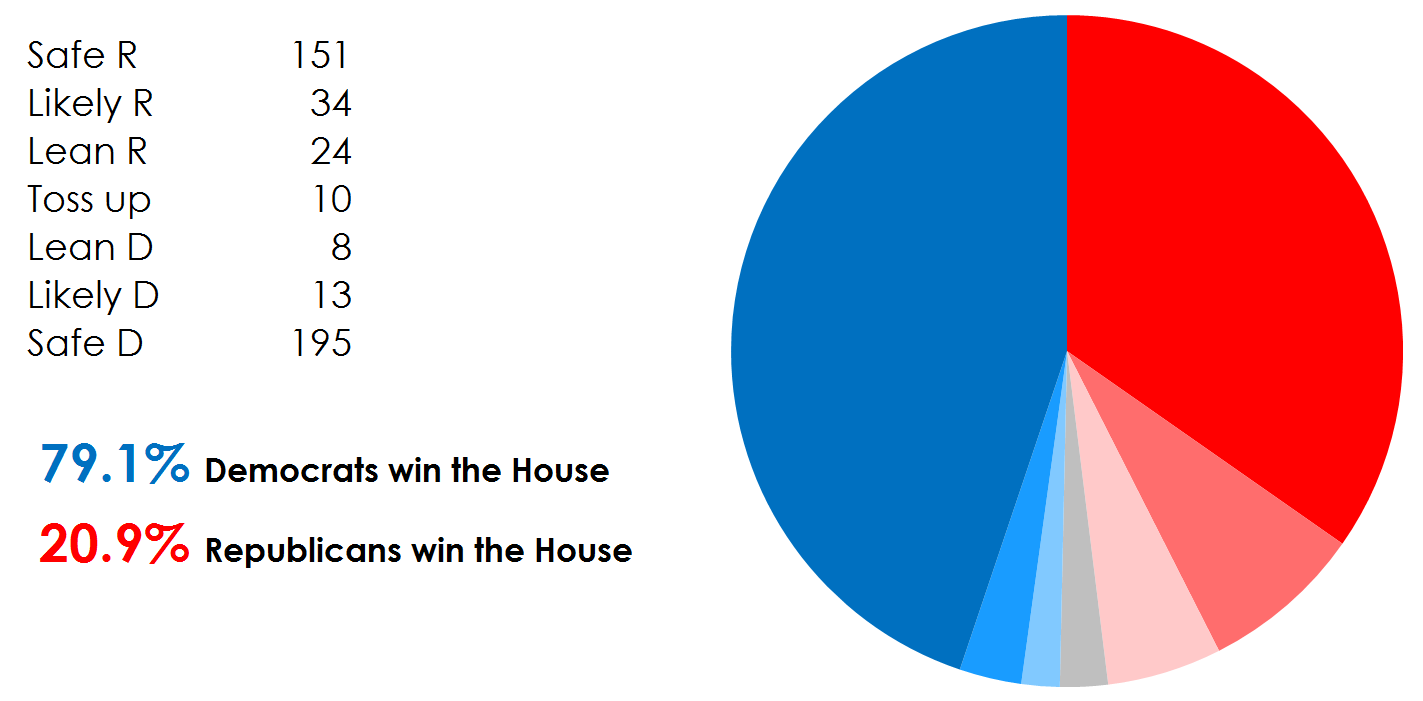
Following their blue wave in 2018, Democrats go into this year’s House elections with 232 representatives, a comfortable majority. To regain control, Republicans need to make extensive gains in an environment even more favourable to Democrats than the 8.5 point lead they enjoyed in 2018. Additionally, Democrats now have the advantage of incumbency in almost every swing seat, having won them off Republican incumbents 2 years ago. As a result, our model gives Democrats a 98% chance of maintaining control of the House, and actually expects them to expand their majority, winning 240 seats on average.

The Senate
In a chamber where California gets the same number of representatives as Wyoming, Democrats are always going to struggle. The Republican structural advantage in the Senate is immense, such that even in 2018 Republicans were able to expand their majority, and now occupy 53 out of the 100 seats. However, in 2018 Democrats had very high exposure in the Senate, with the vast majority of the seats up for election that year occupied by Democrats. This gave the GOP plenty of chances to pick off some of the less secure Democrats in red states they’d won courtesy of excellent years for Democrats in 2006 and 2012. In 2020, the tables are turned as the GOP seeks to hold onto the gains it made in 2014. Now Republicans have high exposure, and could suffer significant losses in this very blue national environment.
12 Democratic and 23 Republican seats are up for election this year, including many Republican held seats in moderately red states. To win control Democrats need to make a net gain of 3 or 4, depending on whether Kamala Harris or Mike Pence is elected to the Vice Presidency, which breaks ties in the Senate. The GOP stands to make a fairly easy gain unseating Doug Jones in Alabama. Following his victory in one of the reddest states in the country as a result of facing an exceptionally unpopular opponent in Roy Moore, Jones has been voting consistently with the Democratic mainstream. It appears he decided that even if he voted as a conservative Democrat in a similar manner to Joe Manchin in deep red West Virginia, Jones would still lose his re-election campaign, so has simply been voting with his party. The only other Republican target is Michigan, where Democrat Gary Peters is facing a small threat to his re-election campaign, but will probably pull through given that Peters and Biden are both consistently leading polls in the state.
Given Biden’s lead in national polling, it’s reasonable to assume that Democrats therefore need to make approximately 4 gains to win control of the Senate. Colorado is an obvious target, Biden is leading there by 14 points and incumbent Cory Gardener has made little effort to appeal to moderates in the state, and trails in polls by a significant margin. If Democrats can’t win this one, they can’t win.
Arizona presents a second strong target for Democrats. This swing state is currently leaning towards Biden, and the Republican incumbent Martha McSally is only an appointed incumbent, not an elected one, and is therefore not expected to command a significant incumbent advantage. Interestingly, in 2018 McSally lost Republican Jeff Flake’s old Senate seat to Democrat Kyrsten Sinema, so if McSally loses again this year she will have been responsible for the GOP losing both Arizona Senate seats in the space of 2 years!
Beyond these 2 targets, Democrats have to work harder to make gains. Maine is a slightly blue state, but incumbent Republican Susan Collins has a moderate reputation, putting her in a much stronger political position than Gardener or McSally. However, since voting in favour of confirming Brett Kavanaugh to the Supreme Court, voters in Maine are increasingly questioning her moderate reputation. She trails slightly in polling, but this is a race that could easily go either way.
Iowa and North Carolina are each somewhat red states with Republican incumbents, so the fact that Democratic challengers have small leads in each of these states is a reflection on the national political situation being very favourable toward Democrats. Additionally, Democrats are only slightly behind in Montana, Kansas, Arkansas, South Carolina, and both races in Georgia. All of these are red states with Republican incumbents, the fact that Democrats are even in contention here must be alarming for the GOP.
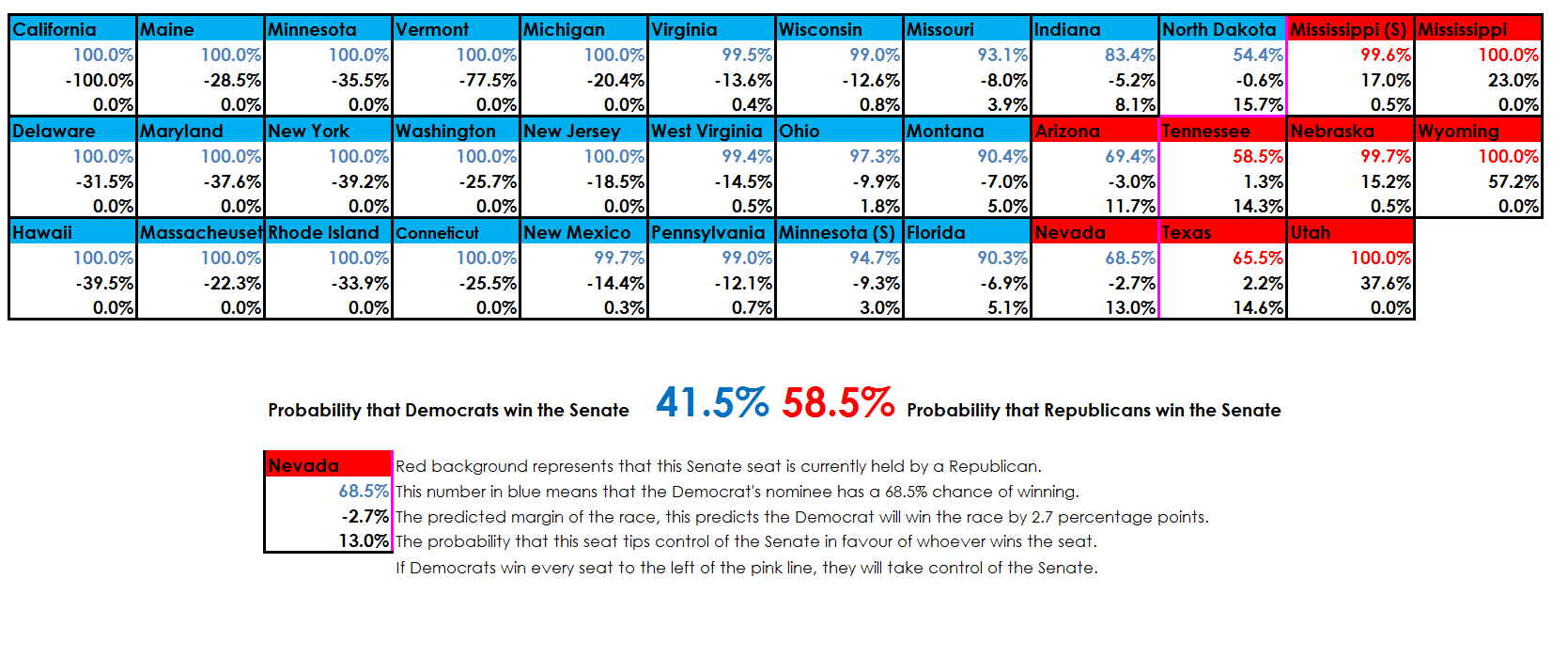
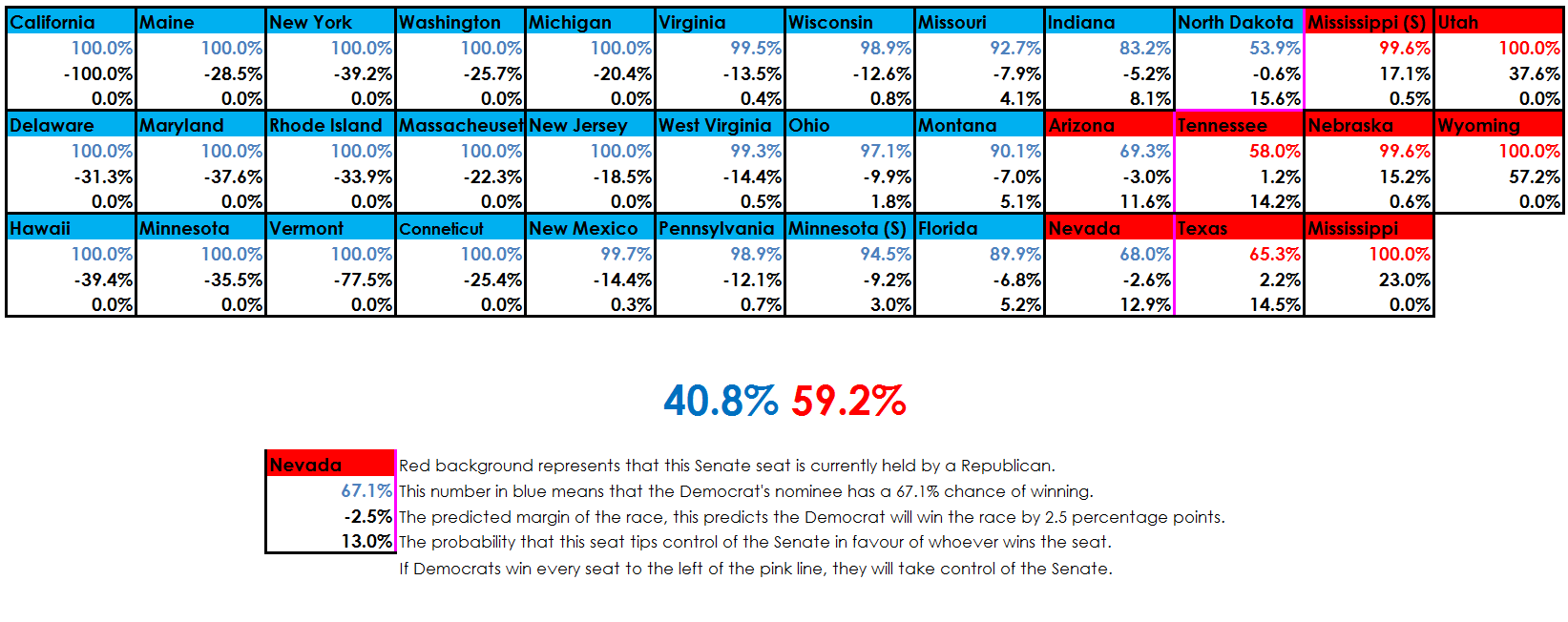
All in all, Democrats have 2 easy opportunities to make gains, and 9 highly competitive races which could go either way. If Democrats win even just a couple of those, they win the Senate. That’s why our model gives Democrats an 81% chance of taking control of the upper chamber. An important note is that the margin could also be extremely important here. If Democrats have only 50 Senators, they would be reliant on conservative Democrat Joe Manchin, whose vote could not be counted on for any liberal policies. If Democrats have 52 seats things are very different, and if Biden were President he could probably pass mainstream Democratic reform through Congress easily. With 55 seats or more, Democrats could run rampant passing whatever progressive policies they so choose, so truly every single competitive race could have an immense impact on politics going forward.

Whilst this piece has focused on the more likely scenario of Democratic victory, it’s worth emphasising the fact that the 2% and 19% chances of Republicans winning the House and Senate respectively are real and should not be ignored. But to hold on even in just the upper chamber, the GOP has a lot of ground to make up. Aside from Susan Collins, Republicans in key races show very limited interest in using moderate rhetoric and policy positions to persuade Independent voters, leading Independents to overwhelmingly back Democrats. While passionate conservative messaging does encourage Republican turnout, it also fires up Democratic turnout, such that Republicans find themselves having to play defence deep within their own territory. If the GOP does indeed suffer a severe defeat this year, they may have to re-examine this strategy.




 RedvBlue Politics