The Iowa Caucuses

Today is the single most important day in the Democratic Primary. Although just 41 pledged delegates are up for grabs tonight, the results and their interpretation will have knock on effects on the rest of the country.

Iowa Predictions

Current Iowa polling shows Sanders and Biden effectively tied with 23% and 22% of the vote respectively. Buttigieg and Warren have each fallen to approximately 15%, while Klobuchar has surged to 11%. However, a naive assessment of these first choice preferences is insufficient in understanding who might win, Iowa is much more complex than that. For each local caucus, candidates who receive 15% or more of first choice preferences immediately bank those votes. However, people who initially supported candidates with less than 15% of the vote will have one opportunity to realign. They could vote for candidates who have already passed the threshold, they could simply go home, or they could support other candidates below the threshold to try and get them up to the 15% mark.

The impact of this system is that second preferences become immensely important. Bear in mind that Iowa voters are generally exceptionally well informed on the candidates due to the intensity of campaigning there, so many will have a well thought out list of preferences. Generally speaking, the field could be sorted into a moderate lane dominated by Biden and Klobuchar and a progressive lane dominated by Sanders and Warren, with Buttigieg in the middle. One would expect voters’ second choices to be from the same ideological lane as their first choice. Campaigns have explicitly reached out to one another to encourage their supporters to select each other as their second choices. The voters themselves will be in the room attempting to convince those realigning to come and support their candidate, all of which makes the process very challenging to predict.

Further complicating matters is the system of delegate allocation, with just 14 delegates being awarded based on the statewide popular vote, and the remaining 27 split between Iowa’s 4 congressional districts. Not only will the allocation be related to the candidates’ popularities in a non-linear manner due to the system of realignment and the 15% threshold, but some of the delegate allocation will be very approximate. Delegates afterall, are people, no candidate can win half a delegate, so the resolution of the system is very low. For example, the 4th congressional district has just 5 delegates, so candidates with very different vote totals could receive the same number of delegates. Furthermore, a candidate with only a few more votes than a competitor could just pip them to the post for an extra delegate, winning far more representation despite having similar vote totals. Currently, our model is predicting that on average, Sanders will win the caucus with 14 delegates. He will be followed by Biden with 12, Warren and Buttigieg with 6 each, Klobuchar with 2, and another candidate with 1, most likely Yang or Steyer.  It is worth noting that these predictions come with a very high degree of uncertainty owing to the complexity of the process.

Media Narratives

This year, for the first time, Iowa will release 3 sets of results. Historically, Iowa simply released the number of delegates allocated to each candidate. However, this year, both the first preference totals and the votes after realignment will be released. It is entirely plausible that these metrics will not all be won by the same candidate, potentially resulting in 2 or even 3 candidates declaring victory tomorrow! Whether or not that happens, the media narrative regarding the results will guide the public interpretation of them. This is not trivial, it is the public interpretation of the Iowa results, especially in terms of tactical voting and changing perceptions of which candidates are electable, which makes Iowa so important. Essentially, it doesn’t help a candidate much to win 13 delegates instead of 12, what matters is whether or not CNN declares them the winner.

Typically, the winner in Iowa receives a substantial bump in the polls. This might be more complicated this year due to potential disagreement over who the “winner” is, but remains electorally crucial. The popularity boost the winner gains is usually greater if they were not expected to win, indeed it may be more useful to consider each candidate’s performance not against one another, but against the respective expectations of each candidate. Currently, the media narratives are effectively, as ever, following intelligent averages of the polls but not accounting enough for uncertainty. Hence Sanders is broadly expected to win a narrow victory over Biden, and Buttigieg has largely fallen out of media coverage. In fact, it is still perfectly likely that any of the top four candidates could win in Iowa, although Sanders does have the best chance. High expectations of Sanders could limit the boost he receives should he win, whereas the potential upside for Buttigieg is massive, something he is counting on given his weak national polling.

Finally, candidates for whom expectations are very low can gain in the polls simply by coming second or third, exceeding expectations. This is effectively what Klobuchar is banking on. With 3 different sets of results it is also plausible that multiple candidates will be clamouring to claim second or third place. As you can probably tell, this is all becoming rather confusing and far too complicated to fit into a typical TV news segment. The manner in which journalists navigate this sea of information, and the spin candidates put on the results, will have a profound impact on the remainder of the primary.

Final Midterm Forecasts

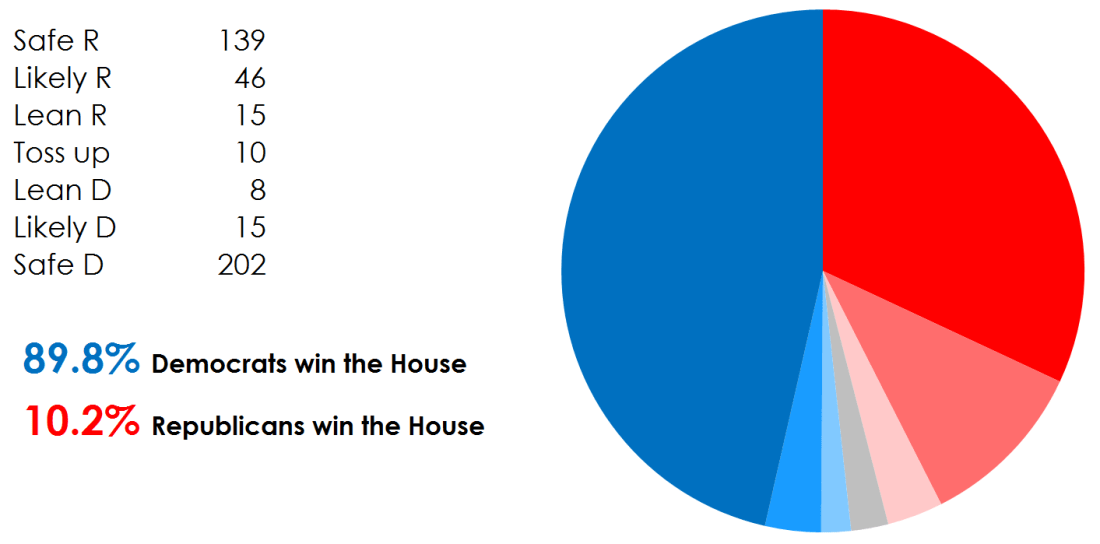
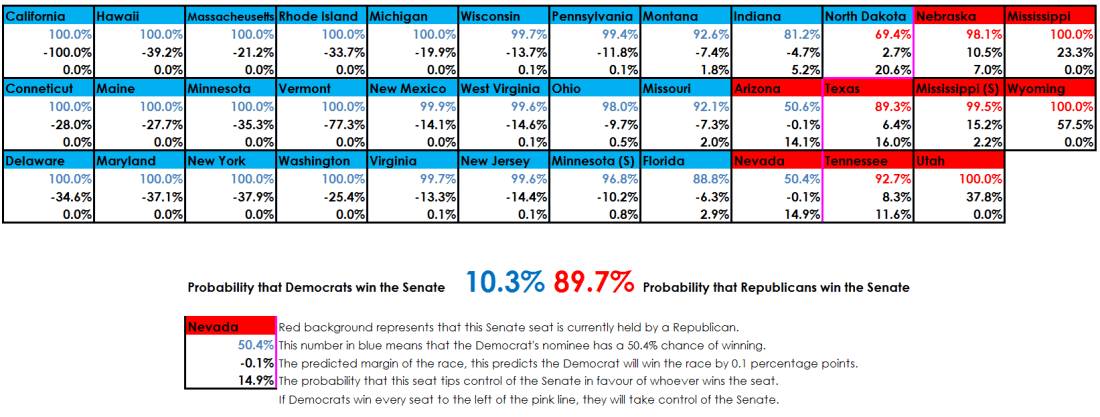
The election is now almost here, and the final RedvBlue forecast is interesting but overall fairly clear and decisive. The top line is that Democrats have about a 10% chance of winning control of both chambers of Congress. The Republicans have a similar chance of full control, and in the remaining 80% of cases, the Democrats will win the House, but the Republicans will hold onto the Senate.

Warning: The approximately 10% chance that Democrats win the Senate and the 10% chance that Republicans win the House are very real. This means that if the election ran a hundred times, we would expect these things to happen about 10 times each. This election is not a dead certainty, and elections are nothing if not surprising, so be prepared!

The Senate

4_11predictions

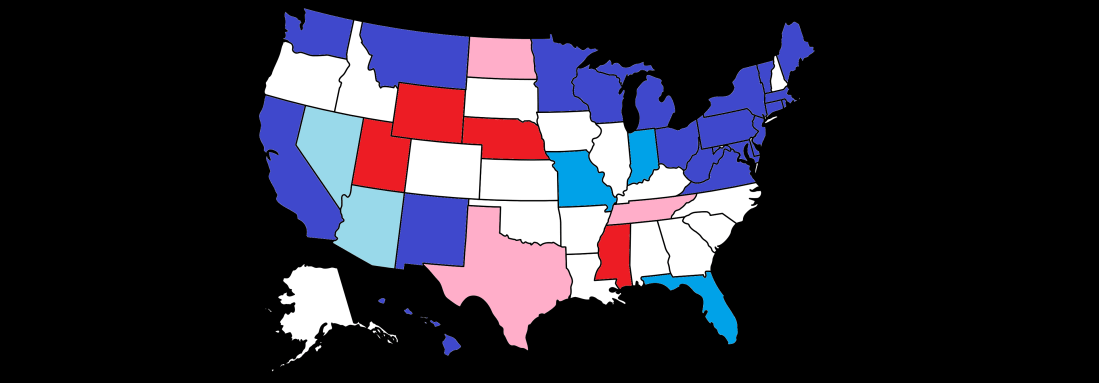
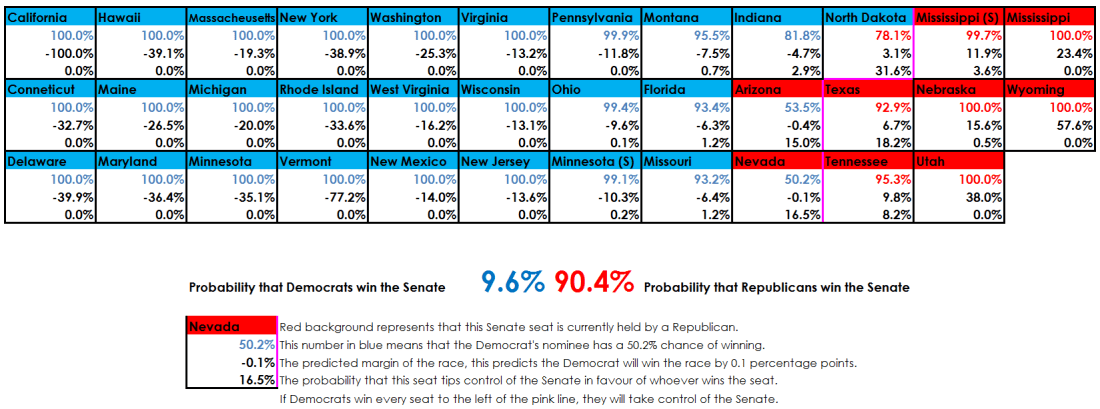
Republicans Ted Cruz and Marsha Blackburn of Texas and Tennessee respectively seem to have successfully fended off fierce challenges from Democrats, and are looking confidently ahead in the polls. The bad news for Republicans is that the Democratic incumbents in deep red states seem to have largely consolidated their positions. West Virginia and Montana look remarkably safe for Democrats, and though the model’s predictions in Missouri and Indiana are nowhere close to certain, the GOP seems significantly behind in both. Only North Dakota has proven vulnerable to Republican efforts to make gains, but this may very well be enough. The highly competitive races remaining in the Senate are Nevada, Arizona, and North Dakota, and Democrats need all 3 to win a majority. Nevada and Arizona are now almost perfect 50:50 toss-ups, it’s really anybody’s guess who’ll win those. But the two states are relatively similar, so it’s reasonable to imagine that they’ll both choose the same party. Meanwhile Democrats need Heidi Heitkamp to pull off a small miracle in North Dakota in order to secure the seat, which has been looking increasingly vulnerable as the election has progressed.

Due to tiny Democratic leads in Nevada and Arizona, going on a seat by seat basis the model predicts that the composition of the Senate will become 50-50, with Vice President Mike Pence giving Republicans the casting vote. But due to the high exposure of several red state Democrats, and very low exposure of the GOP, the average prediction given by the model is that Republicans will come out of the midterms with 52 Senate seats, against only 48 Democrats. The most likely scenario in which this happens would be that Republicans win in North Dakota, Nevada and Arizona.

The House

4_11predictions2

By contrast, the Republicans would need a small miracle to win in the House. Democrats need 23 gains to take control, and New York, California, and New Jersey put together provide almost enough competitive races to allow for that on their own. Democrats are looking great in the New York seats, and in California they’re assisted by there not even being a Republican on the ballot for the Senate race, potentially causing some Republican voters to not bother turning out. However, Democratic Senator Robert Menendez of New Jersey is looking unusually weak this year, having been caught up in a significant scandal, this might weaken Democratic chances across the state. But then there are simply so many other good options for the party to pick up the seats they need. Democrats are looking much stronger across the Midwest than they did in 2016, and Pennsylvania and Minnesota are both heavily laden with competitive districts. On a seat by seat basis, the model predicts the House will go 231-204 in favour of Democrats, representing a net gain of 36 seats. In the House it’s Republicans who are heavily exposed, so the average net gain predicted by the model is 44 seats, leading to a 239-196 House composition, a strong Democratic majority.

Predictions In Full

Here is a full list of our final calls. Although some of these races are toss-ups, this is who we think would win in each race if we had to choose.

Senate – Democratic Wins (Includes Independents who caucus with Democrats)

Arizona, California, Connecticut, Delaware, Florida, Hawaii, Indiana, Maine, Maryland, Massachusetts, Michigan, Minnesota, Minnesota Special, Missouri, Montana, Nevada, New Jersey, New Mexico, New York, Ohio, Pennsylvania, Rhode Island,  Vermont, Virginia, Washington, West Virginia, Wisconsin.

Senate – Republican Wins

Mississippi, Mississippi Special, Nebraska, North Dakota, Tennessee, Texas, Utah, Wyoming.

House – Democratic Wins

Alabama – 7
Alaska – none
Arizona – 1-3, 7, 9
Arkansas – none
California – 2, 3, 5-7, 9-20, 24-41, 43-49, 51-53
Colorado – 1, 2, 6, 7
Connecticut – 1-5
Delaware – at large
Florida – 5, 7, 9, 10, 13-15, 20-24, 26, 27
Georgia – 2, 4, 5, 13
Hawaii – 1, 2
Idaho – none
Illinois – 1-11, 14, 17
Indiana – 1, 7
Iowa – 1-3
Kansas – 2, 3
Kentucky – 3
Louisiana – 2
Maine – 1, 2
Maryland – 2-8
Massachusetts – 1-9
Michigan – 5, 8, 9, 11-14
Minnesota – 1-5, 7
Mississippi – 2
Missouri – 1, 5
Montana – none
Nebraska – none
Nevada – 1, 3, 4
New Hampshire – 1, 2
New Jersey – 1-3, 5-12
New Mexico – 1, 3
New York – 3-10, 12-20, 22, 25, 26
North Carolina – 1, 4, 9, 12
North Dakota – none
Ohio – 3, 9, 11, 13
Oklahoma – none
Oregon – 1, 3-5
Pennsylvania – 2-8, 17, 18
Rhode Island – 1, 2
South Carolina – 6
South Dakota – none
Tennessee – 5, 9
Texas – 7, 9, 15, 16, 18, 20, 28-30, 33-35
Utah – 4
Vermont – at large
Virginia – 3, 4, 7, 8, 10, 11
Washington – 1, 2, 6-10
West Virginia – none
Wisconsin – 2-4
Wyoming – none

House – Republican Wins

Alabama – 1-6
Alaska – at large
Arizona – 4-6, 8
Arkansas – 1-4
California – 1, 4, 8, 21-23, 42, 50
Colorado – 3-5
Connecticut – none
Delaware – none
Florida – 1-4, 6, 8, 11, 12, 16-19, 25
Georgia – 1, 3, 6-12, 14
Hawaii – none
Idaho – at large
Illinois – 12, 13, 15, 16, 18
Indiana – 2-6, 8, 9
Iowa – 4
Kansas – 1, 4
Kentucky – 1, 2, 4-6
Louisiana – 1, 3-6
Maine – none
Maryland – 1
Massachusetts – none
Michigan – 1-4, 6, 7, 10
Minnesota – 6, 8
Mississippi – 1, 3, 4
Missouri – 2-4, 6-8
Montana – at large
Nebraska – 1-3
Nevada – 2
New Hampshire – none
New Jersey – 4
New Mexico – 2
New York – 1, 2, 11, 21, 23, 24, 27
North Carolina – 2, 3, 5-8, 10, 11, 13
North Dakota – at large
Ohio – 1, 2, 4-8, 10, 12, 14-16
Oklahoma – 1-5
Oregon – 2
Pennsylvania – 1, 9-16
Rhode Island – none
South Carolina – 1-5, 7
South Dakota – at large
Tennessee – 1-4, 6-8
Texas – 1-6, 8, 10-14, 17, 19, 21-27, 31, 32, 36
Utah – 1-3
Vermont – none
Virginia – 1, 2, 5, 6, 9
Washington – 3-5
West Virginia – 1-3
Wisconsin – 1, 5-8
Wyoming – at large

Introducing RedvBlue’s House Model

With little more than three weeks until election day, the races for the Senate and the House are intensifying. And after much data collection and programming, the RedvBlue model for the House of Representatives is up and running. Broadly speaking, this works in a similar way to the Senate model, with a few minor additions and alterations such as an increased incumbency advantage that is more uniform for each district, unlike incumbency advantages for Senate seats, which vary significantly depending on the population of the state. The main new feature for the House model is the incorporation of trickle down effects. This is modelling the fact that voters tend to be more motivated to turnout to vote for higher level positions, such as Governor or Senator, than lower ones such as Representative in the House. Therefore if, for example, a Democratic candidate for the Senate in Texas is boosting Democratic enthusiasm in the state and getting left leaning voters to turnout on election day, it’s likely that those voters will also vote for their Democratic House candidate as they happen to be in the polling booth anyway, so Democrats across Texas get a boost.

Without further ado, here are our predictions for 10/14/2018:

13_10predictions2

13_10predictions

Democrats chances in the House are looking very good. There’s certainly a reasonable chance that Republicans hold on to a majority in the House, and that shouldn’t be ignored, but the most likely scenario is that Democrats gain somewhere in the region of 40 seats overall, a fully-fledged blue wave, providing them with a solid majority in the lower chamber of Congress. What’s more, there’s a slim but significant probability that Democrats gain more like 50 or 60 seats overall, which would probably be a sufficiently resounding victory to consolidate the embattled House Minority Leader Nancy Pelosi’s position at the forefront of the party, and would certainly be a worrying sign for Donald Trump. That said, in 2010, the Obama Administration’s first midterm, the Republicans achieved a net gain of 63 seats. Yet Obama went on to win re-election fairly smoothly despite approval ratings only a little higher than Trump’s, so a big blue wave should not be interpreted as too bad a sign for the Trump Administration. The truly remarkable thing for Democrats is that even in the worst case scenario for them that has a reasonable chance of occurring, they actually make a small net gain of around 10 seats. This is simply because Republicans made such huge gains in 2010 and 2014, and held on to almost all of them in 2012 and 2016, that almost all the remaining Democratic seats are in deep blue districts, so Republicans have very few opportunities to make gains, and need to defend some quite blue districts of their own.

By stark contrast, the Senate is looking fantastic for Republicans. Not only have they pulled ahead into comfortable leads in Texas and Tennessee, likely as polls come out showing these red states react to the Kavanaugh confirmation battle, but Nevada and Arizona appear to have turned into much closer races, each now being an almost perfect toss up. But how are these two forecasts so different?

Firstly, it’s worth reiterating just how good the Senate map is for Republicans is this year. Their only really vulnerable seats are in Nevada and Arizona, and they have a wide selection of red state Democratic incumbents to target. Add to that the fact that popular former Governor of Florida Rick Scott is bringing his considerable political weight to bear in the state’s Senate race, posing a serious problem to Democratic incumbent Bill Nelson, and Republican chances end up looking very good despite a left leaning national environment. This overall environment is what is giving Democrats such good odds in the House, where of course all 435 seats are up for election, as opposed to just 35 of the 100 seats in the Senate.

Secondly, the key races in the battles for the House and Senate are happening in very different parts of the country. The most important Senate races are in deep red states like North Dakota, Texas, and Tennessee. Hyper-partisanship means that it’s very difficult for a Democrat to win any of these in 2018. Meanwhile, the most important House races this year seem to largely be in the rural parts of California, New York, and New Jersey. These districts tend to be 5 or 6 percent more Republican leaning than the nation as a whole, but with a national environment leaning towards the Democrats by about 8 points, it’s perfectly plausible that these could change hands. It’s also worth noting the aforementioned trickle down effects in these states. All 3 have Senate races this year, with a Democratic nominee strongly favoured to win. In California, some Republican voters may stay home, as due to the “top two” primary system in California there isn’t even a Republican candidate for Senate on the ballot paper.

Finally, it’s worth remembering that Congress is really, really unpopular, with about a 17% approval rating. This means that incumbency is not actually very powerful this year. This works against Democrats in the Senate, as they are totally reliant upon strong Democratic incumbents in red states holding on for dear life. But in the House, it actually works in their favour. Almost none of their incumbents there are in any kind of danger as they are all in very blue districts, and the key races are being fought over seats currently held by Republicans. All things considered, 2018 is shaping up to be a rough year for incumbents, especially Republicans in the House, which is probably why a full 26 of them retired this year without seeking to run for higher office.

The big picture then, is that the most likely outcome is that of a split Congress, with Democrats controlling the House and Republicans the Senate. This would be very interesting indeed in the polarised politics of the modern day, as politicians may be forced to actually compromise with the other side of the aisle in order to get anything done.

How The GOP Just Won The Supreme Court And The Senate

Predictions as of 10/6/2018, showing a sharp change after a week’s polling and Supreme Court drama:

6_10predictions

Brett Kavanaugh has been confirmed to the Supreme Court of The United States by a Senate vote of 50-48. Everyone voted along party lines, with the exception of Joe Manchin, a Democrat from deep red West Virginia, voting yes. Republican Lisa Murkowski of Alaska simply marked herself as “present”, and Republican Steve Daines did not vote as he was at his daughter’s wedding. With this vote, the GOP has secured a conservative majority in the Supreme Court that will probably last for a decade or more. The Republican party now controls all three branches of the federal government. Simultaneously, their chances of maintaining control of the Senate in 2018 have leapt up dramatically, with polls showing them closing in on the Democrats nationally, and pulling ahead in key Senate races. How?

Put simply, Trump and Republican Senators managed to cast the Kavanaugh battle as a tipping point in a larger political war surrounding #MeToo. Until recently, the #MeToo campaign was something of a silver bullet, drawing vigorous support from Democrats and not too much ire from Republicans. But the battle for Kavanaugh’s confirmation has changed everything. Kavanaugh gave a fiery, passionate and emotional testimony declaring total innocence. Trump claimed that men are assumed to be guilty when accused with sexual assault, claiming “It’s a very scary time for young men in America”, and is one of many on the right implying that Ford is flat out lying in an attempt to bring Kavanaugh down. Republican Senator Lindsey Graham notably said during the hearings that as a single white male from South Carolina he is told he “should just shut up” when discussing issues relating to gender and sexual violence. And there has been a general Republican narrative that the GOP believes Dr Ford and considers her to be a credible witness, but also think that she is mistaken when she says she is 100% certain that her assailant was Kavanaugh.

In doing this, the Republican party has mobilised its base against #MeToo. Trump and Kavanaugh are carefully speaking to a fear of liberal culture, especially feminism, which is widespread amongst the Republican base, and was a crucial part of Trump’s victory in 2016. Lindsey Graham is seeking to relate to this base, as a Southern man who feels his voice is not being heard on these cultural issues. And the overall GOP narrative manages to absolve Kavanaugh of wrongdoing without directly insulting the sympathetic and generally respected Ford. This strategy was never going to convert Democrats or even win over undecided Independents, but it has turned the issue into a strictly partisan battle, and that is all the GOP needs. The tipping point districts in the House are almost all more Republican than the nation as a whole. The three most likely tipping point races in the Senate are Texas, North Dakota, and Tennessee, all of which are deep red states where Trump has positive approval ratings. Democrats need to win over at least some typically Republican voters in order to win the midterms, and individual Democratic candidates running for seats in Republican leaning regions are willing to make compromises on major issues such as gun control and Nancy Pelosi’s potential rise to Speaker of the House. But with Kavanaugh, the GOP convinced its supporters to take up a political stance on which Democratic candidates simply cannot compromise, and the result is political checkmate.

Take one-term Democratic incumbent Heidi Heitkamp running for re-election in North Dakota. In 2012, she won by only 2936 votes in a high turnout race. North Dakota is 17 points more Republican than the nation as a whole, and Trump’s net approval ratings there are about 5-10 points positive. Heitkamp’s choice to oppose Kavanaugh’s nomination has resulted in a huge swing against her in the polls, which have gone from dead even to giving her opponent Kevin Cramer a double-digits lead. This swing is devastating to both her campaign and the national Democratic struggle for the Senate.

Joe Manchin of West Virginia, which is 19 points more Republican than the nation as a whole, took the opposite path. He is the only Democrat in the Senate to vote to support Kavanaugh’s confirmation, and is holding on to a steady lead in the polls. A week ago Trump held a rally in West Virginia, which he used to campaign for Kavanaugh’s nomination. It is crystal clear that Trump has made the confirmation battle a key issue in the midterms, and by doing so has struck a heavy blow to the campaigns of every red state Democrat who voted against Kavanaugh’s confirmation. This includes many of the key Senate races: North Dakota, Indiana, Missouri and Montana. It also poses difficult questions for the Democratic candidates in Texas and Tennessee. It seems reasonable to guess that Trump will be visiting at least some of these states and doing everything in his power to keep voters in them thinking about Kavanaugh, and how their Democratic Senators voted against his confirmation.

Perhaps the confirmation battle will fade from memory as the unrelenting news cycle ploughs on to greater controversies. Or perhaps Kavanaugh’s confirmation with enthuse the Democratic base to turn out to vote in unusually high numbers for a midterm election. Whether one of these nor neither becomes a reality, we can expect a stream of Senate polls over the next week in red states that look at least concerning for Democrats, and our model is sure to react to those, pushing Republican chances of controlling the Senate even higher. Even if Democrats can shore up their defences in Missouri, Montana, Indiana, and Florida, as well as securing pickups in Nevada and Arizona, it’s all for nothing if they can’t win any of Texas, Tennessee, and North Dakota. And right now, all three of those are looking good for the GOP.

Do Democrats Really Have A Chance In Tennessee and Texas?

Predictions as of 10/1/2018:

1_10predictions

Tennessee has not had a Democratic Senator since Jim Sasser left office in 1995 having lost his re-election campaign by 14.3 percentage points, a huge defeat for an incumbent. The state hasn’t voted for a Democratic nominee for the presidency since 1996, and in 2016 Trump won in Tennessee by a full 26 points. Sure, it’s an open race, so Republicans don’t have the advantage of incumbency, but even so, any state-wide election in Tennessee should surely be an open goal for the GOP. And yet our model is giving Republican Marsha Blackburn only a 58.5% chance of winning its Senate race this year, why?

Firstly, Phil Bredesen is no normal Democratic candidate in a red state. He is a former Governor of Tennessee, and a successful one at that, winning re-election in 2006 with 69% of the vote, winning every county and more votes than any gubernatorial candidate in the history of the state, which stretches back to 1796. His reputation as a moderate Democrat makes him far more palatable amongst independents and moderate Republicans in Tennessee than a typical Democrat, and his political experience is practically unrivalled in the state. In 1991 he defeated Councilwoman Betty Nixon with 72% of the vote to become Mayor of Nashville, a position he used to invest heavily in education, building and renovating 75 schools throughout the city. In 1995, no one even ran against his campaign for re-election. His two terms as Mayor built him a formidable base in Nashville, which is incredibly significant given that Nashville’s metro area contains 1.9 million of Tennessee’s 6.7 million inhabitants (about 28%). Since his governorship, he’s been viewed as a potential Democratic presidential candidate, and was vetted for the position of Secretary of Health and Human Services in the Obama Administration. He is a political giant in only a modestly sized state.

Secondly, the national environment is leaning heavily to the left, with Democrats leading the generic congressional ballot by approximately 8.5 points. Tennessee tends to lean about 14 points to the right, taking away 8.5 from 14 leaves only a 5.5 point lead for the Republicans, which is significant, but by no means insurmountable. Add on to this Trump’s poor approval ratings and Tennessee, along with many other red states, looks a lot more competitive.

The national environment is of course also relevant in Texas (much to the distress of millions of pro-secession Texans), but intuitively speaking the state should be even more hostile to a Democratic Senate candidate than Tennessee. Texas hasn’t had a Democratic Senator since 1993 after incumbent Bob Krueger lost his re-election campaign by an impressively abysmal 34.7 points in what the Houston Chronicle called the worst campaign in the state’s modern political history. Texas hasn’t voted for a Democratic nominee for the presidency since narrowly supporting Jimmy Carter in 1976. Furthermore, the Senate seat up for election this year is guarded by none other than well known incumbent and 2016 presidential candidate Ted Cruz, armed with a net worth of over $3 million and a comfortable win in his previous election of 16.1 points, even though it occurred in a Democratic leaning national environment as it coincided with Obama’s re-election campaign. So far Cruz has raised a whopping $24 million, and is extremely keen to hold on to his seat as at the age of only 47, practically a child compared to much of the Senate, he could easily use his position as Senator to set himself up for running for President in 2024.

So how do the Democrats compete with a (comparatively) young man with a net worth of over $3 million? It’s simple, an ever so slightly younger man with a net worth of $9 million, and a proven track record of winning the unwinnable races in politics. In 2005, Beto O’Rourke defeated 2 term incumbent Anthony Cobos to win a seat on the El Paso City Council. In 2012, he ran for the Democratic nomination for the deeply left leaning 16th congressional district in Texas, facing off against 8 term Democratic incumbent Silvestre Reyes, who was endorsed by then President Barack Obama and former President Bill Clinton. Somehow, O’Rourke won the seat, and is now hoping to pull off a third extraordinary victory, seizing onto the key opportunity presented to him in 2018, with Cruz’s approval ratings as Senator going negative, Trump’s approval in Texas surprisingly low, and a heavily left-leaning national environment. Like Cruz, he’s raised $24 million, and he is swiftly fighting to gain the name-recognition he needs to compete with the now famous Cruz with talk show appearances and a campaign with an active social media presence.

Both of these races are looking extremely close, with O’Rourke trailing Cruz by only 3 or 4 points and Bredesen actually ahead of his opponent Marsha Blackburn by about 1 point. Needless to say, if Republicans were to lose either one of these seats, the consequences for them would be extreme. As discussed in a previous article on RedvBlue, Democratic incumbents in deep red seats are an absolute necessity to Democratic hopes of controlling the upper chamber of Congress. O’Rourke in particular is a huge threat to the GOP, if he were to win, he could potentially stay on in the Senate for a long time. He is young, he’s proving himself an adept campaigner, and with the advantage of incumbency could well hold on to the seat in Texas in future elections, especially as the state is becoming less and less Republican as time goes on. These two elections could very well determine who controls the Senate for the next two years or more, and both are extremely competitive.

The New Blue Wall

Predictions as of 9/30/2018:

30_9predictions

The Democrats’ best path to control of the Senate is simple:

  1. Hold all of their current seats
  2. Win the open seat in Arizona
  3. Unseat Republican incumbent Dean Heller in Nevada

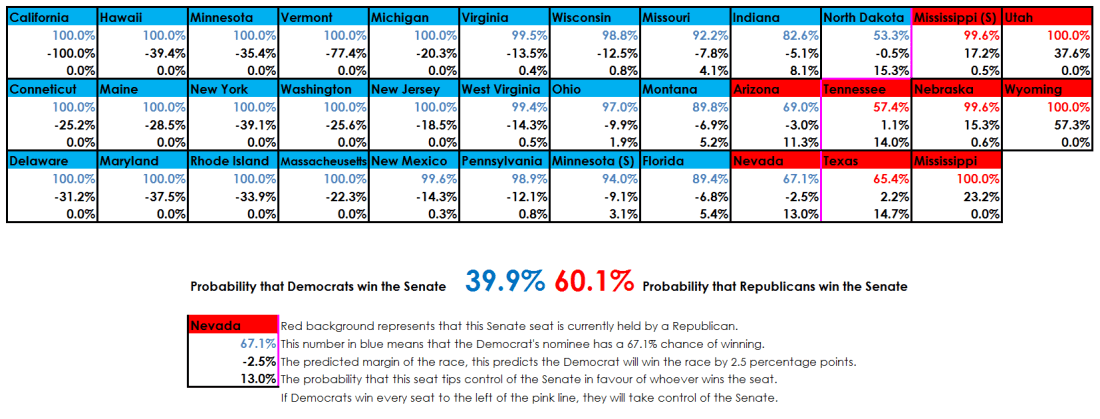
Objectives 2 and 3 are both reasonably achievable. Arizona is 4-5 points more Republican than the nation as a whole, but with the national environment leaning 8-9 points in favour of Democrats, the seat is slightly favoured to turn blue, our model gives the Democrats a 69.3% chance of achieving this. Nevada is 1-2 points more Democratic than the nation as a whole, but the Republican incumbent makes matters more difficult for the Democrats. In fact, the advantage provided by incumbency is even greater in less populous states such as Nevada, such that even in spite of the heavily Democratic national environment, Senator Dean Heller has only a 68% chance of losing their seat.

Surprisingly, it is holding onto all of their current seats that will be most difficult for Democrats. 10 Senate seats currently held by Democrats in states which voted for Donald Trump are up for election, including the deep red states of North Dakota, Indiana, Montana, Missouri, and West Virginia. The GOP is not favoured to win any of these states individually, but overall it is unlikely that the Democrats hold on to every single one of these seats.

Since 1992, Pennsylvania, Michigan and Wisconsin all voted for the Democratic nominee for the presidency in every election up to and including 2012. Together they represented an absolutely crucial block of electoral votes which the Democrats came to depend on and refer to as the “blue wall”. In 2016, the entire election hung on these states, and Donald Trump’s successful campaign to win over non college educated white voters in the Upper Midwest allowed him to tear down the blue wall, simultaneously winning the election and threatening to torpedo Democrats’ future chances in the electoral college for decades to come. If Trump’s coalitions in the Upper Midwest hold up in future elections, Democrats would struggle to reach 270 electoral votes. They need 38 more electoral votes than Clinton won in 2016. Florida provides only 29, and after that they are running out of options without the blue wall. Democratic campaigns would have to make bold attempts to win over voters in quite red states such as North Carolina and Arizona, perhaps with attempts to energise ethnic minorities into turning out in larger numbers than have ever been seen before.

The 5 Democratic Senate seats in deep red states, North Dakota, Indiana, Montana, Missouri, and West Virginia, form a similar blue wall in the Senate. They are absolutely crucial to Democratic hopes of controlling the upper chamber of Congress. There are 27 states rated as leaning significantly more Republican than the nation as a whole, compared to only 15 leaning to the left. Hence, in order to control the Senate the Democrats must be able to win over voters in red states, and this year every Democratic Senate seat in a red state is up for re-election, with the sole exception of Doug Jones’ seat in Alabama. This is extremely unfortunate for the Republicans, as the national environment being so unfavourable for the GOP this year may allow many of the strong Democratic incumbents to survive. Every single incumbent the Republicans can defeat hugely improves their prospects in the Senate over not just the next 6 years but the next two decades. Without the advantage of incumbency, Democrats would be hopeless in these deep red states, and without these crucial seats they would also be hopeless in terms of controlling the Senate as a whole.

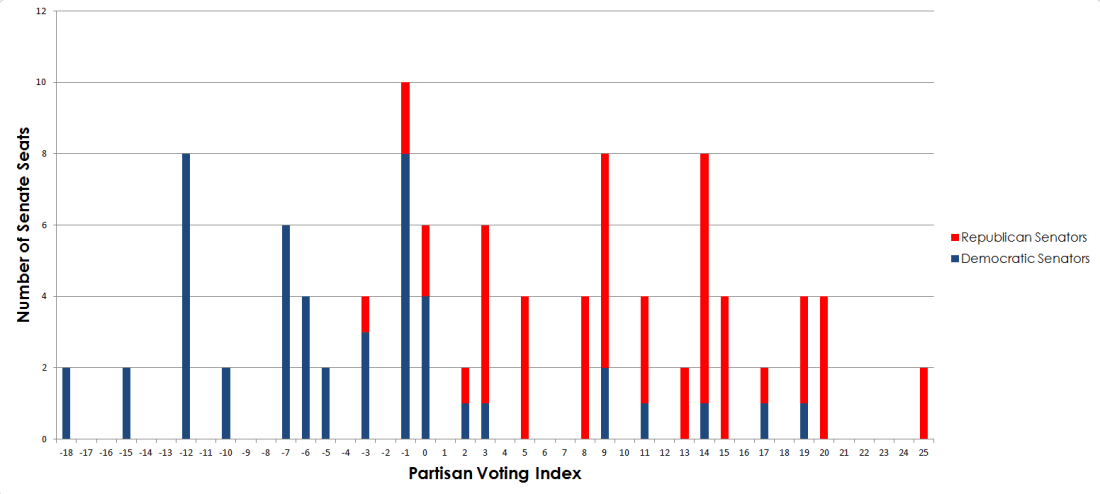
SenatevPVI

In terms of 2018 alone, losing even one seat in this blue wall in the Senate would hugely damage Democratic chances of overall control. The only realistic opportunities for Democrats to make additional gains beyond Nevada and Arizona to make up for losing part of the blue wall are an open race in Tennessee, which leans 14 points to the right, and Texas, where strong Republican incumbent and big name Ted Cruz has $24 million and counting to defend the state, which is a full 8 points more Republican than America overall. So Democrats desperately need their incumbents to lock up key states, before they can truly entertain the possibility of control of the Senate.


Introducing RedvBlue’s Senate Model

Predictions as of 9/29/2018:

29_9predictions

On November the 8th 2016, 129 million Americans went to the polls in one of the most bitterly fought and important elections of the 21st century. Over the course of the following night, Donald Trump’s huge upset victory was gradually unveiled to tens of millions of people watching with baited breath. The result defied almost all predictions, and left the GOP utterly dominant in the political landscape. There were 33 Republican governors, and the GOP held reasonable majorities in both chambers of Congress. As if this weren’t enough, there was an open seat on the Supreme Court, which Trump promptly filled with conservative Neil Gorsuch. With the recent retirement of Justice Anthony Kennedy, Trump and the Senate Republicans are rushing to replace Kennedy with Brett Kavanaugh, whose confirmation would create a conservative majority in the Supreme Court which could last over a decade, securing control of all three branches of government for the GOP.

There’s just one fly in the ointment for the Republicans. The 2018 midterms are just a week and a month away, and various indicators are looking good for the Democrats. Trump’s approval ratings are barely beating 40%, and the Democrats are at an 8-9 point advantage in national polling. Republican structural advantages, such as gerrymandering of house districts, help to mitigate some of this Democratic lead, but there is still a strong possibility that Democrats will be able to wrest control of at least one chamber of Congress. These elections will determine whether or not Trump’s GOP will have 2 years of total control of the federal government. The stakes couldn’t be higher.

RedvBlue’s Senate model attempts to accurately predict the outcome of 2018’s highly competitive battle for the upper chamber of Congress. The model is probabilistic, meaning that it runs hundreds of thousands of simulations of the election, counting the results of each, to eventually arrive at a set of results including the probabilities of various outcomes. The model takes into account the following factors:

  • Polls of individual races, the nation as a whole, and presidential approval. Polls are adjusted according to sample size and the pollster who published them, then weighted against one another, with higher quality polls being attributed more weight than lesser polls and polls with a smaller sample size.
  • Similarity between races. This is a particularly important factor in races with minimal polling. Races are compared against one another according to the nature of the state in which they are taking place, and the candidates running in them. For each race, predictions for similar races are used to infer additional information to assist with accurate simulation.
  • Typical expectations for each race. These are the factors one would look to if there were no polling at all. Most prominent amongst these is the incumbent Senator, their party, and their previous margins of victory. Other factors assisting in weighting the expectations include the partisan lean of the states in which each race is taking place, demographic factors, the population of the state, congressional approval ratings, and fundraising.
  • The time until election day. As the election draws closer, uncertainty will decrease, and the model will weigh polling increasingly heavily.

Currently, the model is showing Republicans slightly ahead in the race for the Senate, despite a seemingly large Democratic lead in the popular vote. This is due to 2018’s Senate map. Of the 35 seats up for election, 26 are already held by Democrats. This gives them few opportunities to make the 2 gains they need to win the Senate. Furthermore, many of these 26 seats are in red states which overwhelmingly voted for Trump in 2016. Races in North Dakota, Indiana, Montana, Missouri and West Virginia all present very real opportunities for Republicans to make gains of their own, which the Democrats can ill afford given their limited options. But if we learned only one thing from 2016, it is that in American politics, just about anything can and will happen.