Predictions as of 9/29/2018:
On November the 8th 2016, 129 million Americans went to the polls in one of the most bitterly fought and important elections of the 21st century. Over the course of the following night, Donald Trump’s huge upset victory was gradually unveiled to tens of millions of people watching with baited breath. The result defied almost all predictions, and left the GOP utterly dominant in the political landscape. There were 33 Republican governors, and the GOP held reasonable majorities in both chambers of Congress. As if this weren’t enough, there was an open seat on the Supreme Court, which Trump promptly filled with conservative Neil Gorsuch. With the recent retirement of Justice Anthony Kennedy, Trump and the Senate Republicans are rushing to replace Kennedy with Brett Kavanaugh, whose confirmation would create a conservative majority in the Supreme Court which could last over a decade, securing control of all three branches of government for the GOP.
There’s just one fly in the ointment for the Republicans. The 2018 midterms are just a week and a month away, and various indicators are looking good for the Democrats. Trump’s approval ratings are barely beating 40%, and the Democrats are at an 8-9 point advantage in national polling. Republican structural advantages, such as gerrymandering of house districts, help to mitigate some of this Democratic lead, but there is still a strong possibility that Democrats will be able to wrest control of at least one chamber of Congress. These elections will determine whether or not Trump’s GOP will have 2 years of total control of the federal government. The stakes couldn’t be higher.
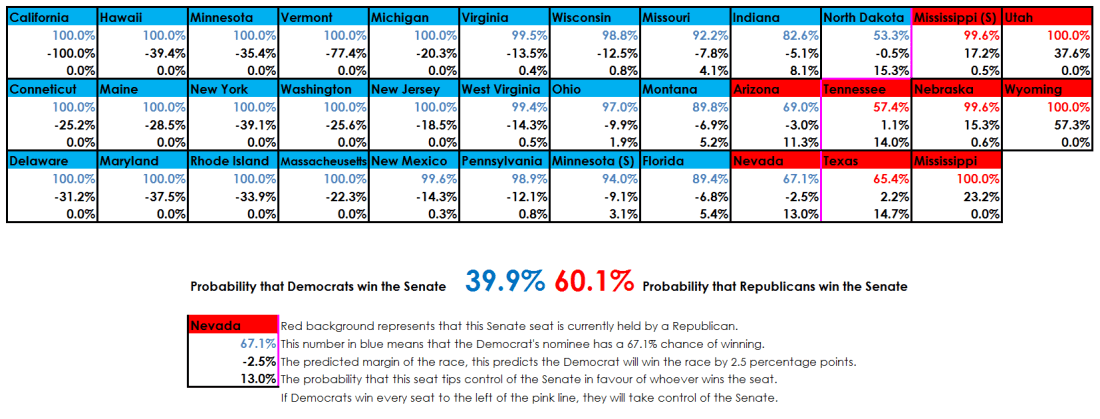
RedvBlue’s Senate model attempts to accurately predict the outcome of 2018’s highly competitive battle for the upper chamber of Congress. The model is probabilistic, meaning that it runs hundreds of thousands of simulations of the election, counting the results of each, to eventually arrive at a set of results including the probabilities of various outcomes. The model takes into account the following factors:
- Polls of individual races, the nation as a whole, and presidential approval. Polls are adjusted according to sample size and the pollster who published them, then weighted against one another, with higher quality polls being attributed more weight than lesser polls and polls with a smaller sample size.
- Similarity between races. This is a particularly important factor in races with minimal polling. Races are compared against one another according to the nature of the state in which they are taking place, and the candidates running in them. For each race, predictions for similar races are used to infer additional information to assist with accurate simulation.
- Typical expectations for each race. These are the factors one would look to if there were no polling at all. Most prominent amongst these is the incumbent Senator, their party, and their previous margins of victory. Other factors assisting in weighting the expectations include the partisan lean of the states in which each race is taking place, demographic factors, the population of the state, congressional approval ratings, and fundraising.
- The time until election day. As the election draws closer, uncertainty will decrease, and the model will weigh polling increasingly heavily.
Currently, the model is showing Republicans slightly ahead in the race for the Senate, despite a seemingly large Democratic lead in the popular vote. This is due to 2018’s Senate map. Of the 35 seats up for election, 26 are already held by Democrats. This gives them few opportunities to make the 2 gains they need to win the Senate. Furthermore, many of these 26 seats are in red states which overwhelmingly voted for Trump in 2016. Races in North Dakota, Indiana, Montana, Missouri and West Virginia all present very real opportunities for Republicans to make gains of their own, which the Democrats can ill afford given their limited options. But if we learned only one thing from 2016, it is that in American politics, just about anything can and will happen.
 RedvBlue Politics