
Predictions as of 9/30/2018:
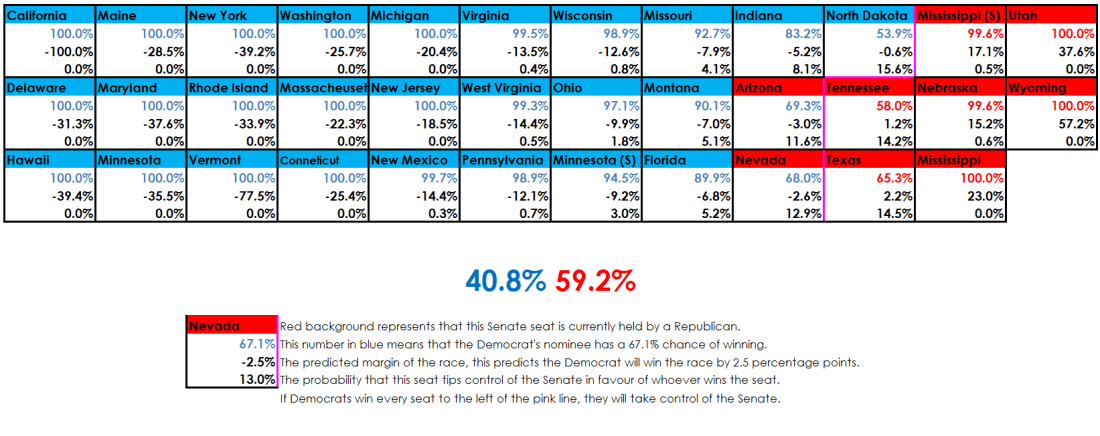
The Democrats’ best path to control of the Senate is simple:
- Hold all of their current seats
- Win the open seat in Arizona
- Unseat Republican incumbent Dean Heller in Nevada
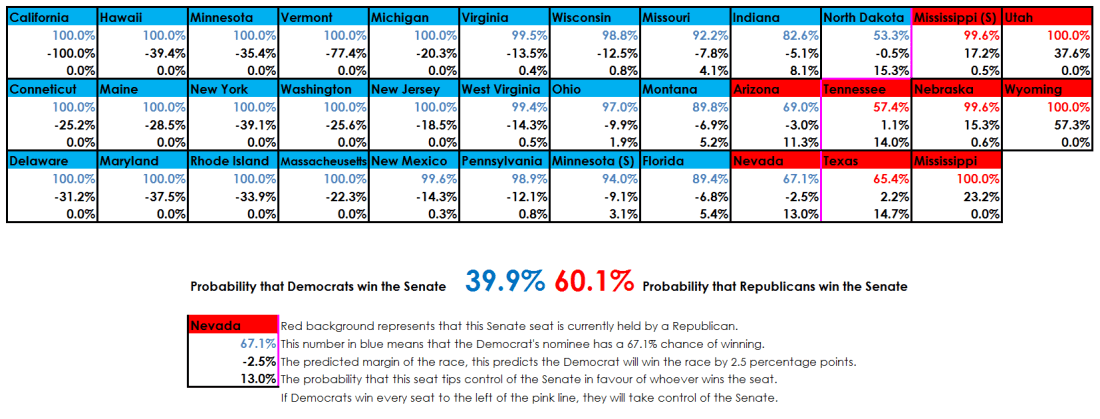
Objectives 2 and 3 are both reasonably achievable. Arizona is 4-5 points more Republican than the nation as a whole, but with the national environment leaning 8-9 points in favour of Democrats, the seat is slightly favoured to turn blue, our model gives the Democrats a 69.3% chance of achieving this. Nevada is 1-2 points more Democratic than the nation as a whole, but the Republican incumbent makes matters more difficult for the Democrats. In fact, the advantage provided by incumbency is even greater in less populous states such as Nevada, such that even in spite of the heavily Democratic national environment, Senator Dean Heller has only a 68% chance of losing their seat.
Surprisingly, it is holding onto all of their current seats that will be most difficult for Democrats. 10 Senate seats currently held by Democrats in states which voted for Donald Trump are up for election, including the deep red states of North Dakota, Indiana, Montana, Missouri, and West Virginia. The GOP is not favoured to win any of these states individually, but overall it is unlikely that the Democrats hold on to every single one of these seats.
Since 1992, Pennsylvania, Michigan and Wisconsin all voted for the Democratic nominee for the presidency in every election up to and including 2012. Together they represented an absolutely crucial block of electoral votes which the Democrats came to depend on and refer to as the “blue wall”. In 2016, the entire election hung on these states, and Donald Trump’s successful campaign to win over non college educated white voters in the Upper Midwest allowed him to tear down the blue wall, simultaneously winning the election and threatening to torpedo Democrats’ future chances in the electoral college for decades to come. If Trump’s coalitions in the Upper Midwest hold up in future elections, Democrats would struggle to reach 270 electoral votes. They need 38 more electoral votes than Clinton won in 2016. Florida provides only 29, and after that they are running out of options without the blue wall. Democratic campaigns would have to make bold attempts to win over voters in quite red states such as North Carolina and Arizona, perhaps with attempts to energise ethnic minorities into turning out in larger numbers than have ever been seen before.
The 5 Democratic Senate seats in deep red states, North Dakota, Indiana, Montana, Missouri, and West Virginia, form a similar blue wall in the Senate. They are absolutely crucial to Democratic hopes of controlling the upper chamber of Congress. There are 27 states rated as leaning significantly more Republican than the nation as a whole, compared to only 15 leaning to the left. Hence, in order to control the Senate the Democrats must be able to win over voters in red states, and this year every Democratic Senate seat in a red state is up for re-election, with the sole exception of Doug Jones’ seat in Alabama. This is extremely unfortunate for the Republicans, as the national environment being so unfavourable for the GOP this year may allow many of the strong Democratic incumbents to survive. Every single incumbent the Republicans can defeat hugely improves their prospects in the Senate over not just the next 6 years but the next two decades. Without the advantage of incumbency, Democrats would be hopeless in these deep red states, and without these crucial seats they would also be hopeless in terms of controlling the Senate as a whole.
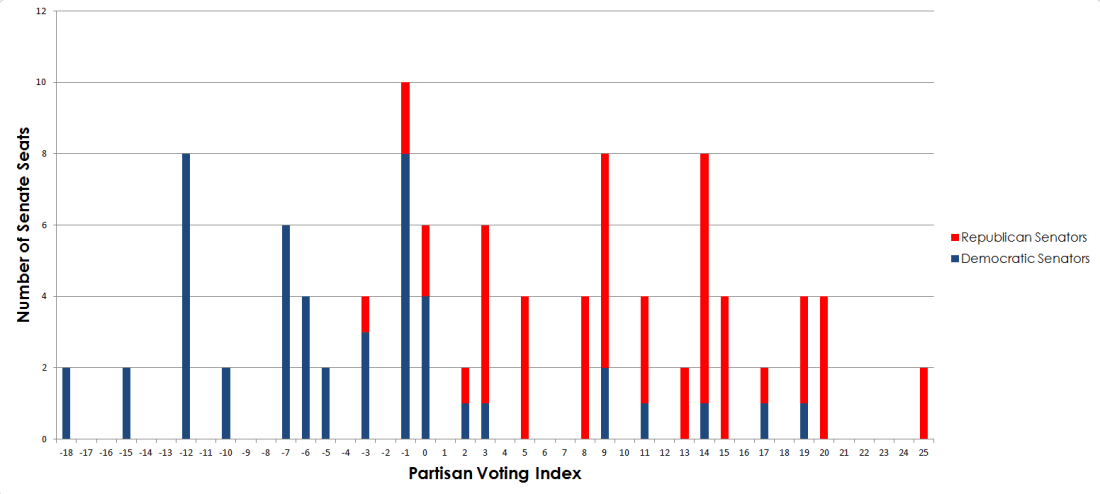
In terms of 2018 alone, losing even one seat in this blue wall in the Senate would hugely damage Democratic chances of overall control. The only realistic opportunities for Democrats to make additional gains beyond Nevada and Arizona to make up for losing part of the blue wall are an open race in Tennessee, which leans 14 points to the right, and Texas, where strong Republican incumbent and big name Ted Cruz has $24 million and counting to defend the state, which is a full 8 points more Republican than America overall. So Democrats desperately need their incumbents to lock up key states, before they can truly entertain the possibility of control of the Senate.

 RedvBlue Politics