
Predictions as of 10/1/2018:
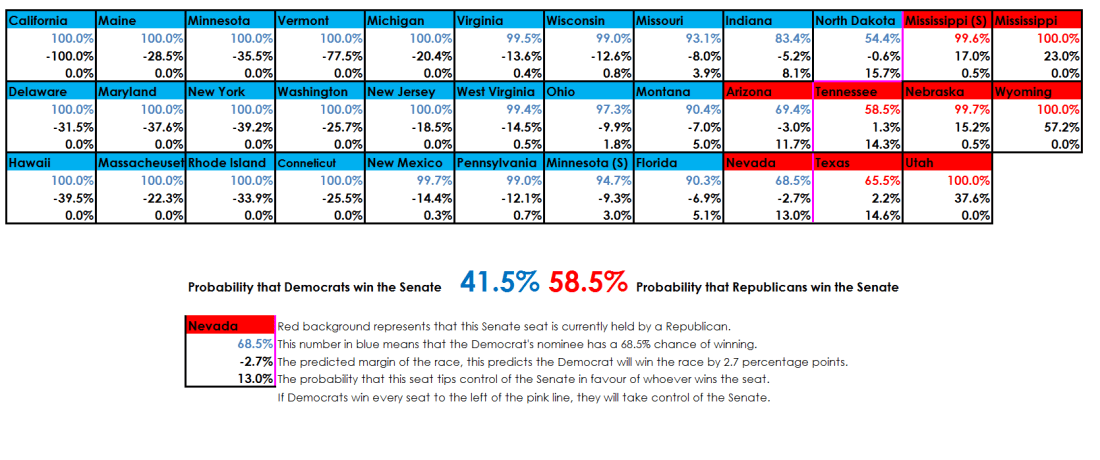
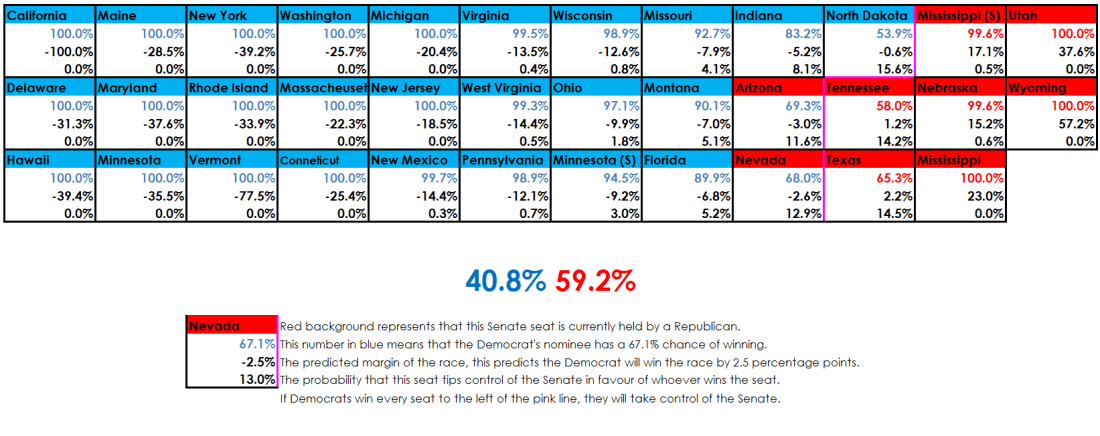
Tennessee has not had a Democratic Senator since Jim Sasser left office in 1995 having lost his re-election campaign by 14.3 percentage points, a huge defeat for an incumbent. The state hasn’t voted for a Democratic nominee for the presidency since 1996, and in 2016 Trump won in Tennessee by a full 26 points. Sure, it’s an open race, so Republicans don’t have the advantage of incumbency, but even so, any state-wide election in Tennessee should surely be an open goal for the GOP. And yet our model is giving Republican Marsha Blackburn only a 58.5% chance of winning its Senate race this year, why?
Firstly, Phil Bredesen is no normal Democratic candidate in a red state. He is a former Governor of Tennessee, and a successful one at that, winning re-election in 2006 with 69% of the vote, winning every county and more votes than any gubernatorial candidate in the history of the state, which stretches back to 1796. His reputation as a moderate Democrat makes him far more palatable amongst independents and moderate Republicans in Tennessee than a typical Democrat, and his political experience is practically unrivalled in the state. In 1991 he defeated Councilwoman Betty Nixon with 72% of the vote to become Mayor of Nashville, a position he used to invest heavily in education, building and renovating 75 schools throughout the city. In 1995, no one even ran against his campaign for re-election. His two terms as Mayor built him a formidable base in Nashville, which is incredibly significant given that Nashville’s metro area contains 1.9 million of Tennessee’s 6.7 million inhabitants (about 28%). Since his governorship, he’s been viewed as a potential Democratic presidential candidate, and was vetted for the position of Secretary of Health and Human Services in the Obama Administration. He is a political giant in only a modestly sized state.
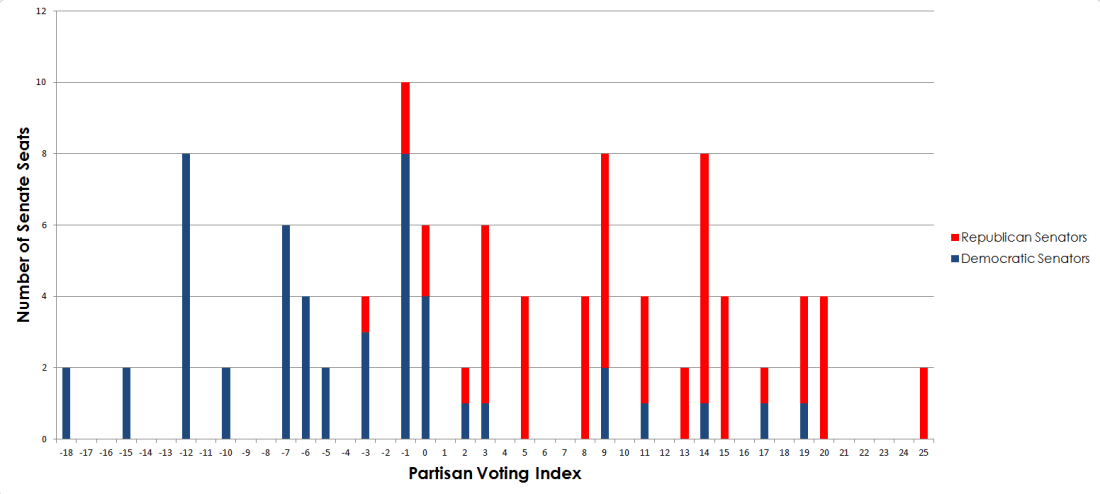
Secondly, the national environment is leaning heavily to the left, with Democrats leading the generic congressional ballot by approximately 8.5 points. Tennessee tends to lean about 14 points to the right, taking away 8.5 from 14 leaves only a 5.5 point lead for the Republicans, which is significant, but by no means insurmountable. Add on to this Trump’s poor approval ratings and Tennessee, along with many other red states, looks a lot more competitive.
The national environment is of course also relevant in Texas (much to the distress of millions of pro-secession Texans), but intuitively speaking the state should be even more hostile to a Democratic Senate candidate than Tennessee. Texas hasn’t had a Democratic Senator since 1993 after incumbent Bob Krueger lost his re-election campaign by an impressively abysmal 34.7 points in what the Houston Chronicle called the worst campaign in the state’s modern political history. Texas hasn’t voted for a Democratic nominee for the presidency since narrowly supporting Jimmy Carter in 1976. Furthermore, the Senate seat up for election this year is guarded by none other than well known incumbent and 2016 presidential candidate Ted Cruz, armed with a net worth of over $3 million and a comfortable win in his previous election of 16.1 points, even though it occurred in a Democratic leaning national environment as it coincided with Obama’s re-election campaign. So far Cruz has raised a whopping $24 million, and is extremely keen to hold on to his seat as at the age of only 47, practically a child compared to much of the Senate, he could easily use his position as Senator to set himself up for running for President in 2024.
So how do the Democrats compete with a (comparatively) young man with a net worth of over $3 million? It’s simple, an ever so slightly younger man with a net worth of $9 million, and a proven track record of winning the unwinnable races in politics. In 2005, Beto O’Rourke defeated 2 term incumbent Anthony Cobos to win a seat on the El Paso City Council. In 2012, he ran for the Democratic nomination for the deeply left leaning 16th congressional district in Texas, facing off against 8 term Democratic incumbent Silvestre Reyes, who was endorsed by then President Barack Obama and former President Bill Clinton. Somehow, O’Rourke won the seat, and is now hoping to pull off a third extraordinary victory, seizing onto the key opportunity presented to him in 2018, with Cruz’s approval ratings as Senator going negative, Trump’s approval in Texas surprisingly low, and a heavily left-leaning national environment. Like Cruz, he’s raised $24 million, and he is swiftly fighting to gain the name-recognition he needs to compete with the now famous Cruz with talk show appearances and a campaign with an active social media presence.
Both of these races are looking extremely close, with O’Rourke trailing Cruz by only 3 or 4 points and Bredesen actually ahead of his opponent Marsha Blackburn by about 1 point. Needless to say, if Republicans were to lose either one of these seats, the consequences for them would be extreme. As discussed in a previous article on RedvBlue, Democratic incumbents in deep red seats are an absolute necessity to Democratic hopes of controlling the upper chamber of Congress. O’Rourke in particular is a huge threat to the GOP, if he were to win, he could potentially stay on in the Senate for a long time. He is young, he’s proving himself an adept campaigner, and with the advantage of incumbency could well hold on to the seat in Texas in future elections, especially as the state is becoming less and less Republican as time goes on. These two elections could very well determine who controls the Senate for the next two years or more, and both are extremely competitive.

 RedvBlue Politics