What Biden’s Win Means For The Political Landscape

After months of voting, counting, and waiting, the General Election is finally over, and it’s bad news for Republicans. In the end, Biden won the popular vote by a fairly convincing 4.5 point margin. This is substantially less than what most opinion polls were predicting, but was still just enough to bring Biden to a victory. Not only did Democrats win back the key swing states of Pennsylvania, Michigan, and Wisconsin, they also picked up Ariziona and Georgia from the Sun Belt, both of which are extremely promising states for the party moving forward. However, in a sense Biden’s margin of victory was quite narrow, as he won the tipping point state of Wisconsin by just 0.6 points, meaning that Trump’s Electoral College advantage was approximately 4 points. Republicans also seem to be solidifying their control of Florida and North Carolina, quashing Democrats’ hopes in these populous and fast growing states.

In the Senate, we expected many of the key races to be close. In the end, many of these toss-ups ended up going to Republicans, continuing the trend we see in these results of Democrats underperforming their polls. The GOP held on in North Carolina and Iowa, and unseated Doug Jones in Alabama, demonstrating once again that incumbency is worth much less than party identity in the current political paradigm, making it extremely difficult for Democrats to hang on in red states and vice versa. Indeed, the vast majority of Senate seats once again simply went to the same party that won the Presidential race in that state. Democrats benefited from this trend by picking up seats in Colorado and Arizona, as well as 2 impressive wins in Georgia, giving Democrats the majority in the Senate they so desperately needed. The sole exception to the rule was Republican Susan Collins in Maine, whose moderate reputation allowed her to clinch a narrow victory in a blue state.

The House was a major source of disappointment for Democrats. While polling indicated the party may enjoy slight gains, instead their majority has been shrunk severely. Those Democrats who remain are a fairly cohesive coalition so should still be somewhat effective, however House votes won’t be the sure thing they once were. Overall across Presidential and Congressional races, we called 98% correctly. Our incorrect calls were all cases of underestimating Republicans, primarily based off inaccurate opinion polling.

Overall, this is a huge win for Democrats. With control of Congress and the White House, they will be able to pass Covid relief bills, implement executive orders, and appoint cabinet secretaries and justices as they please. However, their slim majorities in Congress will likely prevent them from implementing anything radical, as even a couple of Blue Dog Democrats voting against a bill would be enough to block it entirely. Furthermore, they are likely to lose those majorities in the 2022 midterms, meaning they will need to use these 2 years very effectively before Congress becomes split and deadlocked once again.

This election also serves as a vindication of the establishment wing of the Democratic party, demonstrating that mainstream left wing politicians are in fact capable of beating Republicans. This could put the brakes on the Progressive wing of the party, who had previously been arguing that only a radical populist Democrat could excite voters enough to win. It seems likely that in 2024, the Democrats will nominate Biden or Harris for the Presidency, with AOC or any other successor to Bernie Sanders sidelined. Conversely, the GOP may be forced to rethink its strategy. A President failing to win re-election is unusual, as is losing a Senate majority within just 4 years. Whether Republicans stick with Trumpism or fall back to the traditional conservatism of figures such as Mitt Romney will be enormously impactful, and doubtless a major political conflict over the next 4 years.

Finally, Republican structural advantages were cemented and expanded this election, most notably in Trump’s 4 point advantage in the Electoral College, increased from 3 points in 2016. It is entirely possible to envision a scenario where in 2024 or 2028 the Republican nominee wins the Electoral College despite losing the popular vote by 5-10 million ballots. Additionally, the GOP did surprisingly well in State Legislative races, giving them extensive control of the redistricting process coming up in 2021. Meanwhile in many of the states that Democrats do control, they allow the redistricting to be carried out by independent commissions. Ultimately this is likely to mean that Republicans continue to have significant structural advantages in elections for the House and State Legislatures for the next 10 years counterbalancing Democrats’ larger coalition.

Joe Biden Has A 92% Chance Of Winning The Presidency

This year our Presidential forecast model heavily favours Joe Biden to win the 2020 election, in one of the most high turnout elections in American history. Currently leading the national opinion polls by 9 points, and ahead in states with a total of 351 electoral votes, at this stage Biden losing the election would be a significant surprise.

Trump commands a safe lead in 125 electoral votes worth of states (AK, ID, MT, WY, UT, ND, SD, NE, NE-1, NE-3, KS, OK, MO, AR, LA, MS, AL, SC, TN, KY, IN, WV) as compared to Biden’s 216 safe electors (WA, OR, CA, CO, NM, HI, IL, VA, NY, VT, NH, ME, ME-1, MA, RI, CT, NJ, DE, DC, MD). That means that for Biden to win, he needs just 54 electoral votes from the pool of 197 electors across competitive states.

His easiest set of opportunities are in the Upper Midwest, where Trump is 9-10 points behind in Minnesota, Wisconsin, and Michigan, which together have 36 electoral votes. Winning here would require Biden to win back non college-educated white Obama-Trump voters, which by all accounts he appears to be doing. A recent surge in Covid-19 cases in this region (especially Wisconsin), combined with Trump’s terrible approval ratings on the handling of the pandemic, is likely to shore up Biden’s odds in these states.

Biden’s next easiest opportunity is in Pennsylvania with its 20 electoral votes, where he leads by 6-7 points. Pennsylvania is very likely to be the tipping point state this election, playing an absolutely pivotal role. If Biden wins in Minnesota, Wisconsin, Michigan, and Pennsylvania, he wins the Presidency without having to push any further into Republican territory. Our model gives Biden an 88% chance to win The Keystone State, which is a major contributing factor to his lead in our overall forecast.

Although Biden doesn’t strictly need any more targets, in electoral terms it’s generally wise to have backups. If something goes wrong for Biden in Pennsylvania or the Upper Midwest, he could well be rescued by the Sun Belt States. These are Florida, North Carolina, Arizona, and Nevada, which together have 61 electors and represent a more racially diverse cross-section of the population, requiring Biden to excel with groups other than non college-educated white voters. Courtesy of continued strong support from racial minorities as well as improving numbers with older white voters, Biden leads in each of these states by 4-6 points. These states therefore represent a generous cushion for the Biden campaign, and could plausibly decide the election in his favour were he to underperform with white Midwestern voters, but have a strong performance among minority ethnic groups.

Going one step further, Biden has several plausible long shot targets, namely Georgia, Ohio, Iowa, and even Texas. Together these have 78 electoral votes, with Biden and Trump approximately tied in polls in each state. To some extent, states this red have limited relevance in determining the outcome of the election. However, their high number of electors mean that in the event of  Biden victory, they will have a significant impact on the margin of victory in the Electoral College, playing a key role in shaping public perception of the outcome of the election, which could shape both major parties post 2020.

Overall, the current state of the race is bleak for President Trump, however the 8% chance of victory he has in our model is not to be disregarded. It’s important to remember that the President continues to have an Electoral College advantage, such that although national polling may have Biden ahead by 9%, he is only 6-7 points ahead in the most likely tipping point state.

Additionally, it’s worth remembering that polling is not an exact science, and that both random and systematic errors are perfectly common. In 2016, pollsters did not weight polls according to education level, resulting in non college-educated voters being underrepresented in samples which led to a 3 point underestimation of Trump, which was even more extreme in several swing states with large non college-educated white populations. In 2018, pollsters did weight by education and were very accurate indeed, so there’s no particular reason to expect a similar error this year as the problem seems to have been adequately addressed. However, it’s entirely possible that there may be a different systematic polling error, a possibility which our model does account for. If there is such an error, there is no particular reason to believe that it will favour Trump instead of Biden, such that a landslide for Biden is an entirely realistic possibility. Furthermore, even if we did see a 2016 style polling error which underestimated Trump by 3 points nationally and more in several swing states, Biden would still win the election. Biden’s lead is simply much larger than Clinton’s was in 2016, so for Trump to win as the result of a polling error we would have to see a truly historical systematic error across the polling industry.

The other mechanism by which Trump could remain President is via successful large scale voter suppression or vote manipulation attempts. Our model explicitly does not account for these, although it does take into account the normal levels of voter suppression which have been present throughout the nation for a long time. It’s very difficult to gauge what the probability of this happening is, but what you certainly can expect is extensive legal battles, delayed vote counts, and an extremely unusual election night. This year it’s going to be sensible to be patient, and voters will not necessarily know who has won the Presidency by the end of the night. Sticking to reliable, nonpartisan news sources and being aware of the fact that enormous amounts of disinformation are present are going to be critical to surviving the next week with our collective sanity intact.

Is The Electoral College Racist?

Back in August, Rep. Alexandria Ocasio-Cortez posted an Instagram story criticizing the Electoral College, calling it “a scam”. She went on to claim that “the Electoral College has a racial injustice breakdown. Due to severe racial disparities in certain states, the Electoral College effectively weighs white voters over voters of color, as opposed to a ‘one person, one vote’ system where all our votes are counted equally.” Unsurprisingly, her comments faced severe criticism from the right, which railed particularly strongly against the accusation that the Electoral College is racist.

So is it true that this institution makes white votes more powerful than others? Well, this is something we can test. We ran fifty-thousand simulations of presidential elections featuring a generic Republican facing down a generic Democrat. From these, we determined how much of a swing state each state is, and multiplied by their number of electoral votes to create a rating of how powerful each state is in presidential elections. Dividing this rating by the number of voters in the state gives us an index of how powerful each individual vote is. But this isn’t the full picture.

The concept of “wasted votes” is the main metric being used to assess gerrymandering today, that being the practice of drawing district boundaries to the benefit of one party over the other. Two techniques are used to achieve this: “Packing” and “cracking”. Packing is where you draw a district to lean as strongly as possible in favor of one party, packing all their voters into this one district such that the party is far less competitive in every other race. Cracking is where you spread a party’s voters out evenly between many districts such that they make up 40-45% of the population in every race. Therefore even though that party’s voters may make up almost half the population, they win none of the elections.

In the below example, green voters have been packed into one district and cracked across the rest, resulting in the purple party winning 5 out of 6 elections despite having only as many voters as the green party.

Gerrymandering Example

The wasted votes system counts any votes cast for a losing candidate as wasted. Therefore if most elections are being won by the same party by small margins, a huge number of the other party’s votes will be judged as wasted, effectively detecting cracking. Additionally, votes cast for the winning candidate above the 50% they need to win the election are also judged as wasted. This detects packing, as if a candidate wins a huge proportion of the vote, a large number of their votes will be wasted.

Applying this to our analysis has a profound effect on the results, leaving only the votes that make an impact on the election. For example, Republican votes in Upstate New York are discounted as these Republicans are not represented at all in the Electoral College. Additionally, many Democratic votes used to build up enormous margins in New England are treated as wasted as you don’t get any more electors for winning by 30% than by 1%. This leaves us with a clear picture of which votes count, and how much they count for. By studying the race of each voter, this information is used to calculate the average power associated with a white, black, Hispanic, and Asian vote.

The results of this are striking. On average, white votes are worth 1.13 times the average vote. Black and Hispanic votes are each worth 0.81 times the average, and Asian votes just 0.75 times. This can be attributed to a few factors. Firstly, the all important Midwestern swing states (Michigan, Wisconsin, Ohio, Pennsylvania, Minnesota, Iowa) are disproportionately white. Also, many non-white voters are packed into big cities in safe Democratic states like California, such that many of their votes are wasted running up the score in landslide elections. Additionally, many black voters are “cracked” across the South, forming large minorities which can never muster up quite enough votes to win the state.

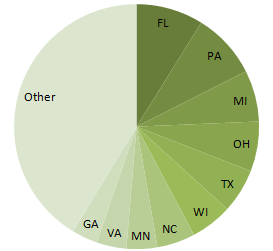
To understand better how the disparity in representation arises, we can look at which states are the main sources of each race’s voting power. White voters are fairly evenly distributed, so the breakdown for white voters shows the main sources of their voting power being the key swing states around the country, the only surprise being the increasingly competitive Texas.

W

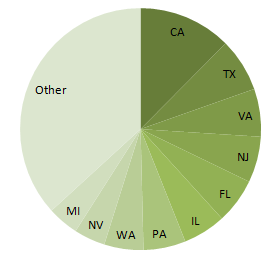
By contrast, black voters are much more concentrated in the South, and so their voting power is much more dependent on Florida, perhaps the only really competitive Southern state. However black voters are also able to exert their influence in Virginia, where since the Obama era they have formed the basis of a slim but surprisingly sturdy Democratic majority. Georgia and North Carolina also score highly as a result of large ethnic minorities coming increasingly close to flipping these states in what would be a major coup for Democrats. Interestingly, large black populations in Alabama, Mississippi, South Carolina, Louisiana and Tennessee wield very little power in the Electoral College as they almost all vote Democrat, but these states never go blue.

B

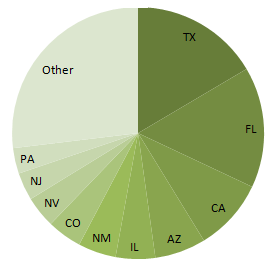
Hispanic voting power is even more concentrated, with five states providing over half their electoral influence. Texas and Florida each provide 16% of their voting power, with most of the key swing states having only small Hispanic populations. The importance of their role in Texas cannot be overstated. Although the Texas GOP may lose Hispanic voters by large margins almost all the time, the fact that these margins are closer to 50 points than 90 means Republicans are still able to win in this racially diverse state. In other words, it doesn’t just matter whether you win or lose a demographic, the exact margin is crucial. Arizona, a new swing state, is another key source of Hispanic voting power, and is sure to be getting a lot of attention in 2020.

H

Finally, many Asian voters are packed into coastal cities in deep blue states, with very little presence in any swing state, resulting in their minimal electoral influence and the absence of any concerted efforts to win them over.

A

This analysis suggests that AOC is probably correct at least in her assertion that due to the Electoral College, white votes count for more than those of voters of color. There is also potential for this to be reversed in the future, as increasing non-white populations in Texas, Arizona, Florida, North Carolina and Georgia could make these states increasingly competitive, and perhaps even turn them reliably blue as has happened in Virginia. But for now, tens of millions of Americans are forced to live with the reality that their vote has little to no impact, and this disempowered group is disproportionately non-white.