
Back in August, Rep. Alexandria Ocasio-Cortez posted an Instagram story criticizing the Electoral College, calling it “a scam”. She went on to claim that “the Electoral College has a racial injustice breakdown. Due to severe racial disparities in certain states, the Electoral College effectively weighs white voters over voters of color, as opposed to a ‘one person, one vote’ system where all our votes are counted equally.” Unsurprisingly, her comments faced severe criticism from the right, which railed particularly strongly against the accusation that the Electoral College is racist.
So is it true that this institution makes white votes more powerful than others? Well, this is something we can test. We ran fifty-thousand simulations of presidential elections featuring a generic Republican facing down a generic Democrat. From these, we determined how much of a swing state each state is, and multiplied by their number of electoral votes to create a rating of how powerful each state is in presidential elections. Dividing this rating by the number of voters in the state gives us an index of how powerful each individual vote is. But this isn’t the full picture.
The concept of “wasted votes” is the main metric being used to assess gerrymandering today, that being the practice of drawing district boundaries to the benefit of one party over the other. Two techniques are used to achieve this: “Packing” and “cracking”. Packing is where you draw a district to lean as strongly as possible in favor of one party, packing all their voters into this one district such that the party is far less competitive in every other race. Cracking is where you spread a party’s voters out evenly between many districts such that they make up 40-45% of the population in every race. Therefore even though that party’s voters may make up almost half the population, they win none of the elections.
In the below example, green voters have been packed into one district and cracked across the rest, resulting in the purple party winning 5 out of 6 elections despite having only as many voters as the green party.
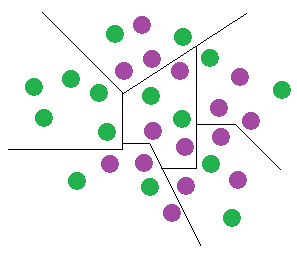
The wasted votes system counts any votes cast for a losing candidate as wasted. Therefore if most elections are being won by the same party by small margins, a huge number of the other party’s votes will be judged as wasted, effectively detecting cracking. Additionally, votes cast for the winning candidate above the 50% they need to win the election are also judged as wasted. This detects packing, as if a candidate wins a huge proportion of the vote, a large number of their votes will be wasted.
Applying this to our analysis has a profound effect on the results, leaving only the votes that make an impact on the election. For example, Republican votes in Upstate New York are discounted as these Republicans are not represented at all in the Electoral College. Additionally, many Democratic votes used to build up enormous margins in New England are treated as wasted as you don’t get any more electors for winning by 30% than by 1%. This leaves us with a clear picture of which votes count, and how much they count for. By studying the race of each voter, this information is used to calculate the average power associated with a white, black, Hispanic, and Asian vote.
The results of this are striking. On average, white votes are worth 1.13 times the average vote. Black and Hispanic votes are each worth 0.81 times the average, and Asian votes just 0.75 times. This can be attributed to a few factors. Firstly, the all important Midwestern swing states (Michigan, Wisconsin, Ohio, Pennsylvania, Minnesota, Iowa) are disproportionately white. Also, many non-white voters are packed into big cities in safe Democratic states like California, such that many of their votes are wasted running up the score in landslide elections. Additionally, many black voters are “cracked” across the South, forming large minorities which can never muster up quite enough votes to win the state.
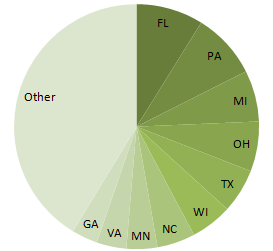
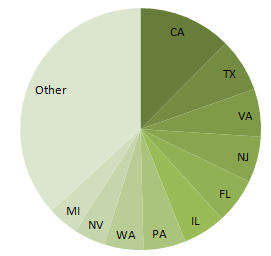
To understand better how the disparity in representation arises, we can look at which states are the main sources of each race’s voting power. White voters are fairly evenly distributed, so the breakdown for white voters shows the main sources of their voting power being the key swing states around the country, the only surprise being the increasingly competitive Texas.
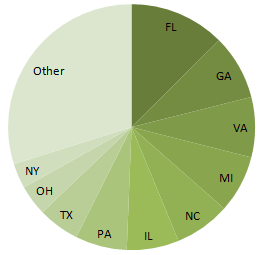
By contrast, black voters are much more concentrated in the South, and so their voting power is much more dependent on Florida, perhaps the only really competitive Southern state. However black voters are also able to exert their influence in Virginia, where since the Obama era they have formed the basis of a slim but surprisingly sturdy Democratic majority. Georgia and North Carolina also score highly as a result of large ethnic minorities coming increasingly close to flipping these states in what would be a major coup for Democrats. Interestingly, large black populations in Alabama, Mississippi, South Carolina, Louisiana and Tennessee wield very little power in the Electoral College as they almost all vote Democrat, but these states never go blue.
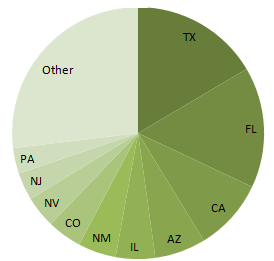
Hispanic voting power is even more concentrated, with five states providing over half their electoral influence. Texas and Florida each provide 16% of their voting power, with most of the key swing states having only small Hispanic populations. The importance of their role in Texas cannot be overstated. Although the Texas GOP may lose Hispanic voters by large margins almost all the time, the fact that these margins are closer to 50 points than 90 means Republicans are still able to win in this racially diverse state. In other words, it doesn’t just matter whether you win or lose a demographic, the exact margin is crucial. Arizona, a new swing state, is another key source of Hispanic voting power, and is sure to be getting a lot of attention in 2020.
Finally, many Asian voters are packed into coastal cities in deep blue states, with very little presence in any swing state, resulting in their minimal electoral influence and the absence of any concerted efforts to win them over.
This analysis suggests that AOC is probably correct at least in her assertion that due to the Electoral College, white votes count for more than those of voters of color. There is also potential for this to be reversed in the future, as increasing non-white populations in Texas, Arizona, Florida, North Carolina and Georgia could make these states increasingly competitive, and perhaps even turn them reliably blue as has happened in Virginia. But for now, tens of millions of Americans are forced to live with the reality that their vote has little to no impact, and this disempowered group is disproportionately non-white.
 RedvBlue Politics