The election is now almost here, and the final RedvBlue forecast is interesting but overall fairly clear and decisive. The top line is that Democrats have about a 10% chance of winning control of both chambers of Congress. The Republicans have a similar chance of full control, and in the remaining 80% of cases, the Democrats will win the House, but the Republicans will hold onto the Senate.
Warning: The approximately 10% chance that Democrats win the Senate and the 10% chance that Republicans win the House are very real. This means that if the election ran a hundred times, we would expect these things to happen about 10 times each. This election is not a dead certainty, and elections are nothing if not surprising, so be prepared!
The Senate
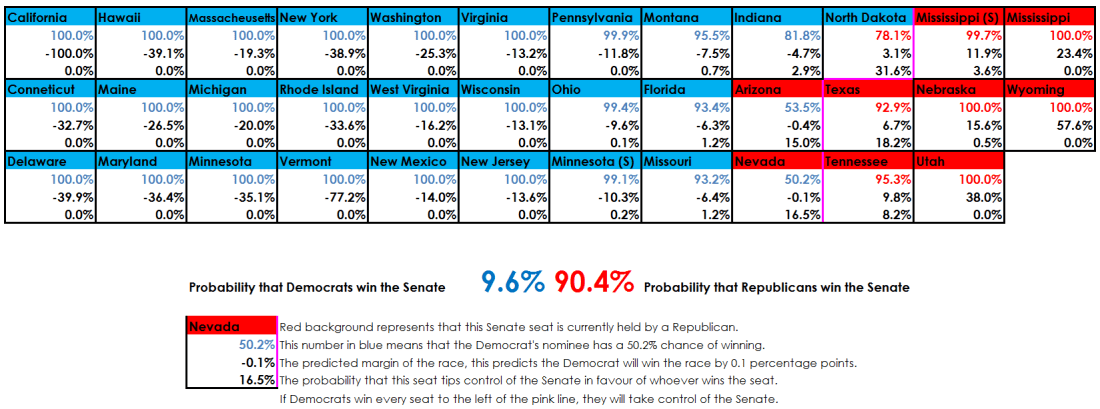
Republicans Ted Cruz and Marsha Blackburn of Texas and Tennessee respectively seem to have successfully fended off fierce challenges from Democrats, and are looking confidently ahead in the polls. The bad news for Republicans is that the Democratic incumbents in deep red states seem to have largely consolidated their positions. West Virginia and Montana look remarkably safe for Democrats, and though the model’s predictions in Missouri and Indiana are nowhere close to certain, the GOP seems significantly behind in both. Only North Dakota has proven vulnerable to Republican efforts to make gains, but this may very well be enough. The highly competitive races remaining in the Senate are Nevada, Arizona, and North Dakota, and Democrats need all 3 to win a majority. Nevada and Arizona are now almost perfect 50:50 toss-ups, it’s really anybody’s guess who’ll win those. But the two states are relatively similar, so it’s reasonable to imagine that they’ll both choose the same party. Meanwhile Democrats need Heidi Heitkamp to pull off a small miracle in North Dakota in order to secure the seat, which has been looking increasingly vulnerable as the election has progressed.
Due to tiny Democratic leads in Nevada and Arizona, going on a seat by seat basis the model predicts that the composition of the Senate will become 50-50, with Vice President Mike Pence giving Republicans the casting vote. But due to the high exposure of several red state Democrats, and very low exposure of the GOP, the average prediction given by the model is that Republicans will come out of the midterms with 52 Senate seats, against only 48 Democrats. The most likely scenario in which this happens would be that Republicans win in North Dakota, Nevada and Arizona.
The House
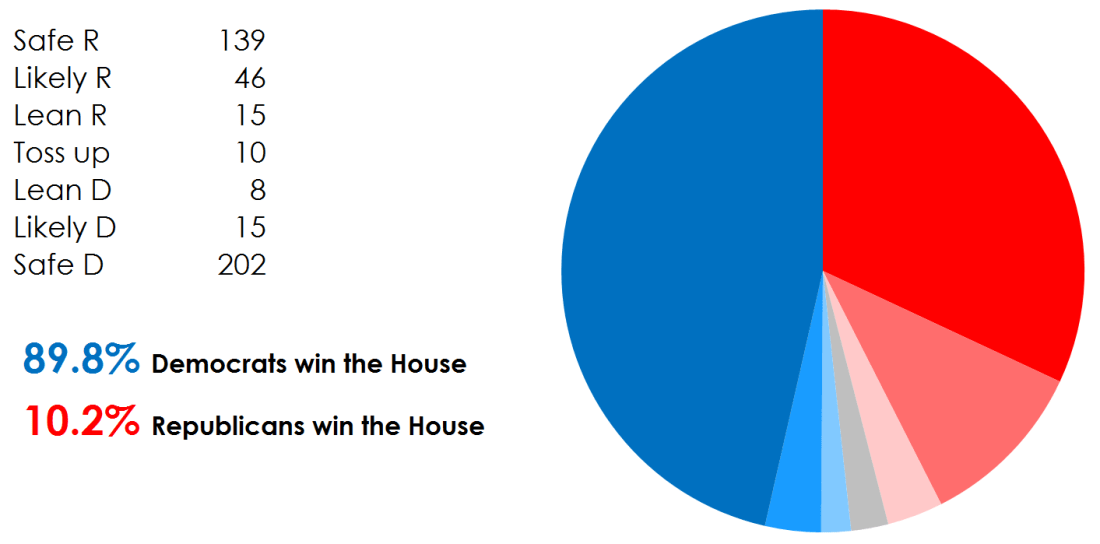
By contrast, the Republicans would need a small miracle to win in the House. Democrats need 23 gains to take control, and New York, California, and New Jersey put together provide almost enough competitive races to allow for that on their own. Democrats are looking great in the New York seats, and in California they’re assisted by there not even being a Republican on the ballot for the Senate race, potentially causing some Republican voters to not bother turning out. However, Democratic Senator Robert Menendez of New Jersey is looking unusually weak this year, having been caught up in a significant scandal, this might weaken Democratic chances across the state. But then there are simply so many other good options for the party to pick up the seats they need. Democrats are looking much stronger across the Midwest than they did in 2016, and Pennsylvania and Minnesota are both heavily laden with competitive districts. On a seat by seat basis, the model predicts the House will go 231-204 in favour of Democrats, representing a net gain of 36 seats. In the House it’s Republicans who are heavily exposed, so the average net gain predicted by the model is 44 seats, leading to a 239-196 House composition, a strong Democratic majority.
Predictions In Full
Here is a full list of our final calls. Although some of these races are toss-ups, this is who we think would win in each race if we had to choose.
Senate – Democratic Wins (Includes Independents who caucus with Democrats)
Arizona, California, Connecticut, Delaware, Florida, Hawaii, Indiana, Maine, Maryland, Massachusetts, Michigan, Minnesota, Minnesota Special, Missouri, Montana, Nevada, New Jersey, New Mexico, New York, Ohio, Pennsylvania, Rhode Island, Vermont, Virginia, Washington, West Virginia, Wisconsin.
Senate – Republican Wins
Mississippi, Mississippi Special, Nebraska, North Dakota, Tennessee, Texas, Utah, Wyoming.
House – Democratic Wins
Alabama – 7
Alaska – none
Arizona – 1-3, 7, 9
Arkansas – none
California – 2, 3, 5-7, 9-20, 24-41, 43-49, 51-53
Colorado – 1, 2, 6, 7
Connecticut – 1-5
Delaware – at large
Florida – 5, 7, 9, 10, 13-15, 20-24, 26, 27
Georgia – 2, 4, 5, 13
Hawaii – 1, 2
Idaho – none
Illinois – 1-11, 14, 17
Indiana – 1, 7
Iowa – 1-3
Kansas – 2, 3
Kentucky – 3
Louisiana – 2
Maine – 1, 2
Maryland – 2-8
Massachusetts – 1-9
Michigan – 5, 8, 9, 11-14
Minnesota – 1-5, 7
Mississippi – 2
Missouri – 1, 5
Montana – none
Nebraska – none
Nevada – 1, 3, 4
New Hampshire – 1, 2
New Jersey – 1-3, 5-12
New Mexico – 1, 3
New York – 3-10, 12-20, 22, 25, 26
North Carolina – 1, 4, 9, 12
North Dakota – none
Ohio – 3, 9, 11, 13
Oklahoma – none
Oregon – 1, 3-5
Pennsylvania – 2-8, 17, 18
Rhode Island – 1, 2
South Carolina – 6
South Dakota – none
Tennessee – 5, 9
Texas – 7, 9, 15, 16, 18, 20, 28-30, 33-35
Utah – 4
Vermont – at large
Virginia – 3, 4, 7, 8, 10, 11
Washington – 1, 2, 6-10
West Virginia – none
Wisconsin – 2-4
Wyoming – none
House – Republican Wins
Alabama – 1-6
Alaska – at large
Arizona – 4-6, 8
Arkansas – 1-4
California – 1, 4, 8, 21-23, 42, 50
Colorado – 3-5
Connecticut – none
Delaware – none
Florida – 1-4, 6, 8, 11, 12, 16-19, 25
Georgia – 1, 3, 6-12, 14
Hawaii – none
Idaho – at large
Illinois – 12, 13, 15, 16, 18
Indiana – 2-6, 8, 9
Iowa – 4
Kansas – 1, 4
Kentucky – 1, 2, 4-6
Louisiana – 1, 3-6
Maine – none
Maryland – 1
Massachusetts – none
Michigan – 1-4, 6, 7, 10
Minnesota – 6, 8
Mississippi – 1, 3, 4
Missouri – 2-4, 6-8
Montana – at large
Nebraska – 1-3
Nevada – 2
New Hampshire – none
New Jersey – 4
New Mexico – 2
New York – 1, 2, 11, 21, 23, 24, 27
North Carolina – 2, 3, 5-8, 10, 11, 13
North Dakota – at large
Ohio – 1, 2, 4-8, 10, 12, 14-16
Oklahoma – 1-5
Oregon – 2
Pennsylvania – 1, 9-16
Rhode Island – none
South Carolina – 1-5, 7
South Dakota – at large
Tennessee – 1-4, 6-8
Texas – 1-6, 8, 10-14, 17, 19, 21-27, 31, 32, 36
Utah – 1-3
Vermont – none
Virginia – 1, 2, 5, 6, 9
Washington – 3-5
West Virginia – 1-3
Wisconsin – 1, 5-8
Wyoming – at large

 RedvBlue Politics