With little more than three weeks until election day, the races for the Senate and the House are intensifying. And after much data collection and programming, the RedvBlue model for the House of Representatives is up and running. Broadly speaking, this works in a similar way to the Senate model, with a few minor additions and alterations such as an increased incumbency advantage that is more uniform for each district, unlike incumbency advantages for Senate seats, which vary significantly depending on the population of the state. The main new feature for the House model is the incorporation of trickle down effects. This is modelling the fact that voters tend to be more motivated to turnout to vote for higher level positions, such as Governor or Senator, than lower ones such as Representative in the House. Therefore if, for example, a Democratic candidate for the Senate in Texas is boosting Democratic enthusiasm in the state and getting left leaning voters to turnout on election day, it’s likely that those voters will also vote for their Democratic House candidate as they happen to be in the polling booth anyway, so Democrats across Texas get a boost.
Without further ado, here are our predictions for 10/14/2018:

Democrats chances in the House are looking very good. There’s certainly a reasonable chance that Republicans hold on to a majority in the House, and that shouldn’t be ignored, but the most likely scenario is that Democrats gain somewhere in the region of 40 seats overall, a fully-fledged blue wave, providing them with a solid majority in the lower chamber of Congress. What’s more, there’s a slim but significant probability that Democrats gain more like 50 or 60 seats overall, which would probably be a sufficiently resounding victory to consolidate the embattled House Minority Leader Nancy Pelosi’s position at the forefront of the party, and would certainly be a worrying sign for Donald Trump. That said, in 2010, the Obama Administration’s first midterm, the Republicans achieved a net gain of 63 seats. Yet Obama went on to win re-election fairly smoothly despite approval ratings only a little higher than Trump’s, so a big blue wave should not be interpreted as too bad a sign for the Trump Administration. The truly remarkable thing for Democrats is that even in the worst case scenario for them that has a reasonable chance of occurring, they actually make a small net gain of around 10 seats. This is simply because Republicans made such huge gains in 2010 and 2014, and held on to almost all of them in 2012 and 2016, that almost all the remaining Democratic seats are in deep blue districts, so Republicans have very few opportunities to make gains, and need to defend some quite blue districts of their own.
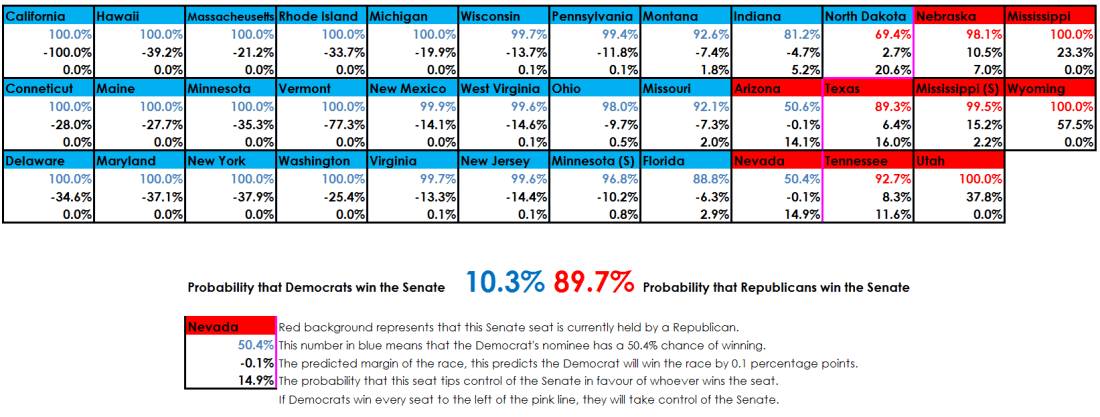
By stark contrast, the Senate is looking fantastic for Republicans. Not only have they pulled ahead into comfortable leads in Texas and Tennessee, likely as polls come out showing these red states react to the Kavanaugh confirmation battle, but Nevada and Arizona appear to have turned into much closer races, each now being an almost perfect toss up. But how are these two forecasts so different?
Firstly, it’s worth reiterating just how good the Senate map is for Republicans is this year. Their only really vulnerable seats are in Nevada and Arizona, and they have a wide selection of red state Democratic incumbents to target. Add to that the fact that popular former Governor of Florida Rick Scott is bringing his considerable political weight to bear in the state’s Senate race, posing a serious problem to Democratic incumbent Bill Nelson, and Republican chances end up looking very good despite a left leaning national environment. This overall environment is what is giving Democrats such good odds in the House, where of course all 435 seats are up for election, as opposed to just 35 of the 100 seats in the Senate.
Secondly, the key races in the battles for the House and Senate are happening in very different parts of the country. The most important Senate races are in deep red states like North Dakota, Texas, and Tennessee. Hyper-partisanship means that it’s very difficult for a Democrat to win any of these in 2018. Meanwhile, the most important House races this year seem to largely be in the rural parts of California, New York, and New Jersey. These districts tend to be 5 or 6 percent more Republican leaning than the nation as a whole, but with a national environment leaning towards the Democrats by about 8 points, it’s perfectly plausible that these could change hands. It’s also worth noting the aforementioned trickle down effects in these states. All 3 have Senate races this year, with a Democratic nominee strongly favoured to win. In California, some Republican voters may stay home, as due to the “top two” primary system in California there isn’t even a Republican candidate for Senate on the ballot paper.
Finally, it’s worth remembering that Congress is really, really unpopular, with about a 17% approval rating. This means that incumbency is not actually very powerful this year. This works against Democrats in the Senate, as they are totally reliant upon strong Democratic incumbents in red states holding on for dear life. But in the House, it actually works in their favour. Almost none of their incumbents there are in any kind of danger as they are all in very blue districts, and the key races are being fought over seats currently held by Republicans. All things considered, 2018 is shaping up to be a rough year for incumbents, especially Republicans in the House, which is probably why a full 26 of them retired this year without seeking to run for higher office.
The big picture then, is that the most likely outcome is that of a split Congress, with Democrats controlling the House and Republicans the Senate. This would be very interesting indeed in the polarised politics of the modern day, as politicians may be forced to actually compromise with the other side of the aisle in order to get anything done.

 RedvBlue Politics