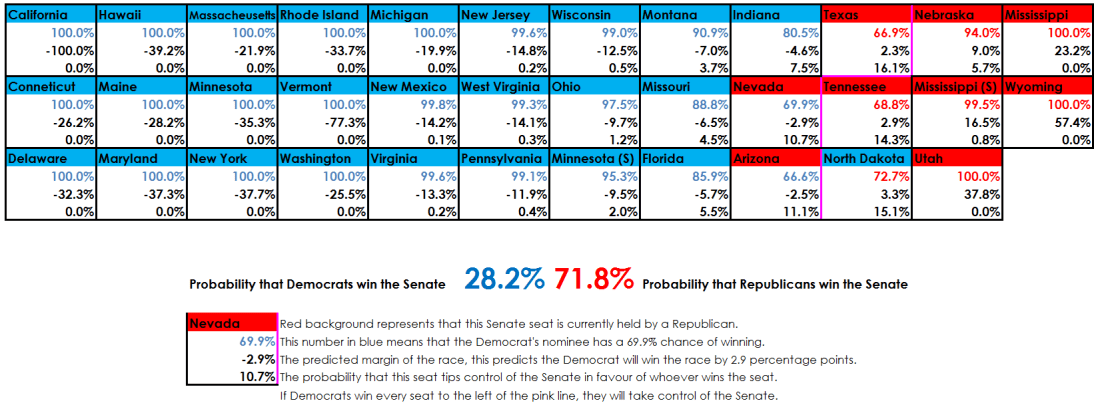
Predictions as of 10/6/2018, showing a sharp change after a week’s polling and Supreme Court drama:
Brett Kavanaugh has been confirmed to the Supreme Court of The United States by a Senate vote of 50-48. Everyone voted along party lines, with the exception of Joe Manchin, a Democrat from deep red West Virginia, voting yes. Republican Lisa Murkowski of Alaska simply marked herself as “present”, and Republican Steve Daines did not vote as he was at his daughter’s wedding. With this vote, the GOP has secured a conservative majority in the Supreme Court that will probably last for a decade or more. The Republican party now controls all three branches of the federal government. Simultaneously, their chances of maintaining control of the Senate in 2018 have leapt up dramatically, with polls showing them closing in on the Democrats nationally, and pulling ahead in key Senate races. How?
Put simply, Trump and Republican Senators managed to cast the Kavanaugh battle as a tipping point in a larger political war surrounding #MeToo. Until recently, the #MeToo campaign was something of a silver bullet, drawing vigorous support from Democrats and not too much ire from Republicans. But the battle for Kavanaugh’s confirmation has changed everything. Kavanaugh gave a fiery, passionate and emotional testimony declaring total innocence. Trump claimed that men are assumed to be guilty when accused with sexual assault, claiming “It’s a very scary time for young men in America”, and is one of many on the right implying that Ford is flat out lying in an attempt to bring Kavanaugh down. Republican Senator Lindsey Graham notably said during the hearings that as a single white male from South Carolina he is told he “should just shut up” when discussing issues relating to gender and sexual violence. And there has been a general Republican narrative that the GOP believes Dr Ford and considers her to be a credible witness, but also think that she is mistaken when she says she is 100% certain that her assailant was Kavanaugh.
In doing this, the Republican party has mobilised its base against #MeToo. Trump and Kavanaugh are carefully speaking to a fear of liberal culture, especially feminism, which is widespread amongst the Republican base, and was a crucial part of Trump’s victory in 2016. Lindsey Graham is seeking to relate to this base, as a Southern man who feels his voice is not being heard on these cultural issues. And the overall GOP narrative manages to absolve Kavanaugh of wrongdoing without directly insulting the sympathetic and generally respected Ford. This strategy was never going to convert Democrats or even win over undecided Independents, but it has turned the issue into a strictly partisan battle, and that is all the GOP needs. The tipping point districts in the House are almost all more Republican than the nation as a whole. The three most likely tipping point races in the Senate are Texas, North Dakota, and Tennessee, all of which are deep red states where Trump has positive approval ratings. Democrats need to win over at least some typically Republican voters in order to win the midterms, and individual Democratic candidates running for seats in Republican leaning regions are willing to make compromises on major issues such as gun control and Nancy Pelosi’s potential rise to Speaker of the House. But with Kavanaugh, the GOP convinced its supporters to take up a political stance on which Democratic candidates simply cannot compromise, and the result is political checkmate.
Take one-term Democratic incumbent Heidi Heitkamp running for re-election in North Dakota. In 2012, she won by only 2936 votes in a high turnout race. North Dakota is 17 points more Republican than the nation as a whole, and Trump’s net approval ratings there are about 5-10 points positive. Heitkamp’s choice to oppose Kavanaugh’s nomination has resulted in a huge swing against her in the polls, which have gone from dead even to giving her opponent Kevin Cramer a double-digits lead. This swing is devastating to both her campaign and the national Democratic struggle for the Senate.
Joe Manchin of West Virginia, which is 19 points more Republican than the nation as a whole, took the opposite path. He is the only Democrat in the Senate to vote to support Kavanaugh’s confirmation, and is holding on to a steady lead in the polls. A week ago Trump held a rally in West Virginia, which he used to campaign for Kavanaugh’s nomination. It is crystal clear that Trump has made the confirmation battle a key issue in the midterms, and by doing so has struck a heavy blow to the campaigns of every red state Democrat who voted against Kavanaugh’s confirmation. This includes many of the key Senate races: North Dakota, Indiana, Missouri and Montana. It also poses difficult questions for the Democratic candidates in Texas and Tennessee. It seems reasonable to guess that Trump will be visiting at least some of these states and doing everything in his power to keep voters in them thinking about Kavanaugh, and how their Democratic Senators voted against his confirmation.
Perhaps the confirmation battle will fade from memory as the unrelenting news cycle ploughs on to greater controversies. Or perhaps Kavanaugh’s confirmation with enthuse the Democratic base to turn out to vote in unusually high numbers for a midterm election. Whether one of these nor neither becomes a reality, we can expect a stream of Senate polls over the next week in red states that look at least concerning for Democrats, and our model is sure to react to those, pushing Republican chances of controlling the Senate even higher. Even if Democrats can shore up their defences in Missouri, Montana, Indiana, and Florida, as well as securing pickups in Nevada and Arizona, it’s all for nothing if they can’t win any of Texas, Tennessee, and North Dakota. And right now, all three of those are looking good for the GOP.

 RedvBlue Politics
Another concise, informative and thought provoking read.
LikeLiked by 1 person